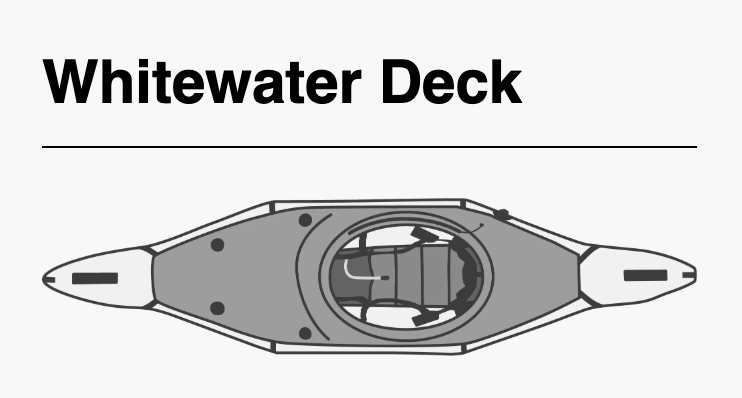
The Chinook is not a whitewater boat.
It’s not designed to run technical rapids. It’s designed to travel long rivers efficiently, safely, and sustainably. In river travel, what matters isn’t speed or intensity — it’s endurance. The Chinook is built around that idea.
Cruising Performance on Large Rivers
Rivers have current, which might suggest self-propulsion is less critical — but headwind sections, wide slow reaches, and long flatwater stretches require consistent active paddling. Poor hull efficiency becomes physically costly over multi-day distances.
The Chinook’s long waterline reduces drag and maintains momentum. The practical result: less effort per kilometer in slow sections, a paddling experience closer to a hardshell touring kayak, and a meaningful daily range advantage over round-hull packrafts.
On wide, large-volume rivers, this cruising capability is a significant operational asset.
Class II Capability — Not to Attack, But to Pass Through
The Chinook handles Class II lightwater sections. Mild rapids. Light wave trains. Moderate current changes.
The important distinction: this isn’t about running whitewater for sport. Multi-day river journeys naturally include sections with light technical water — and the Chinook’s stability, thigh straps, and overall control allow those sections to be navigated confidently rather than portaged unnecessarily.
The goal is to pass through safely, not to push limits.
Real-World Fields Where the Chinook Performs
The Chinook reaches its full potential on rivers like these:
The Teshio River in Hokkaido — wide, long, slow-flowing. Alaska’s Noatak River. Canadian Shield backcountry routes linking lakes and rivers over extended distances.
What these environments share: substantial total distance, stable water volume, and likely portage requirements at some point. The Chinook is designed to handle all of these within a single packrafting system.
The Removable Skeg — A River-Specific Feature
The Chinook’s removable skeg improves straight-line tracking in slow current and headwind conditions. On winding technical sections or in shallow water, it can be removed entirely.
Rivers vary constantly. The ability to adjust the hull’s directional bias to match the current section is a practical advantage on long trips where conditions change by the hour.
The Value of a Portable Cruising Boat
Hardshell touring kayak-level cruising performance. Approximately 4.1 kg. Packable enough to carry through forest on a portage to the next river.
This combination is not available in any other category of paddling craft. A kayak that paddles like a touring hardshell but travels like a backpack is the Chinook’s defining value.
The Chinook enables the kind of travel that links rivers and land — not just river paddling, but expedition movement across terrain.
Who It’s For on Rivers
The Chinook fits paddlers planning long-distance river descents; multi-day travel on large rivers; backcountry routes combining lakes and rivers with portage sections; and anyone who wants to prioritize cruising efficiency over technical whitewater performance.
For sustained technical rapids, dedicated whitewater models are the appropriate choice. The Chinook is a river travel tool, not a river performance tool.
The Conclusion
The Chinook isn’t built for excitement. It’s built to cover distance — reliably, over multiple days.
Drifting quietly down a large river. Following the map to the next campsite. Carrying the boat across a ridge to the watershed beyond.
That is what the Chinook is designed to do.
Product Link
Chinook 210d Flatwater Spray Deck [2026] — One Size → Web Shop

コメント