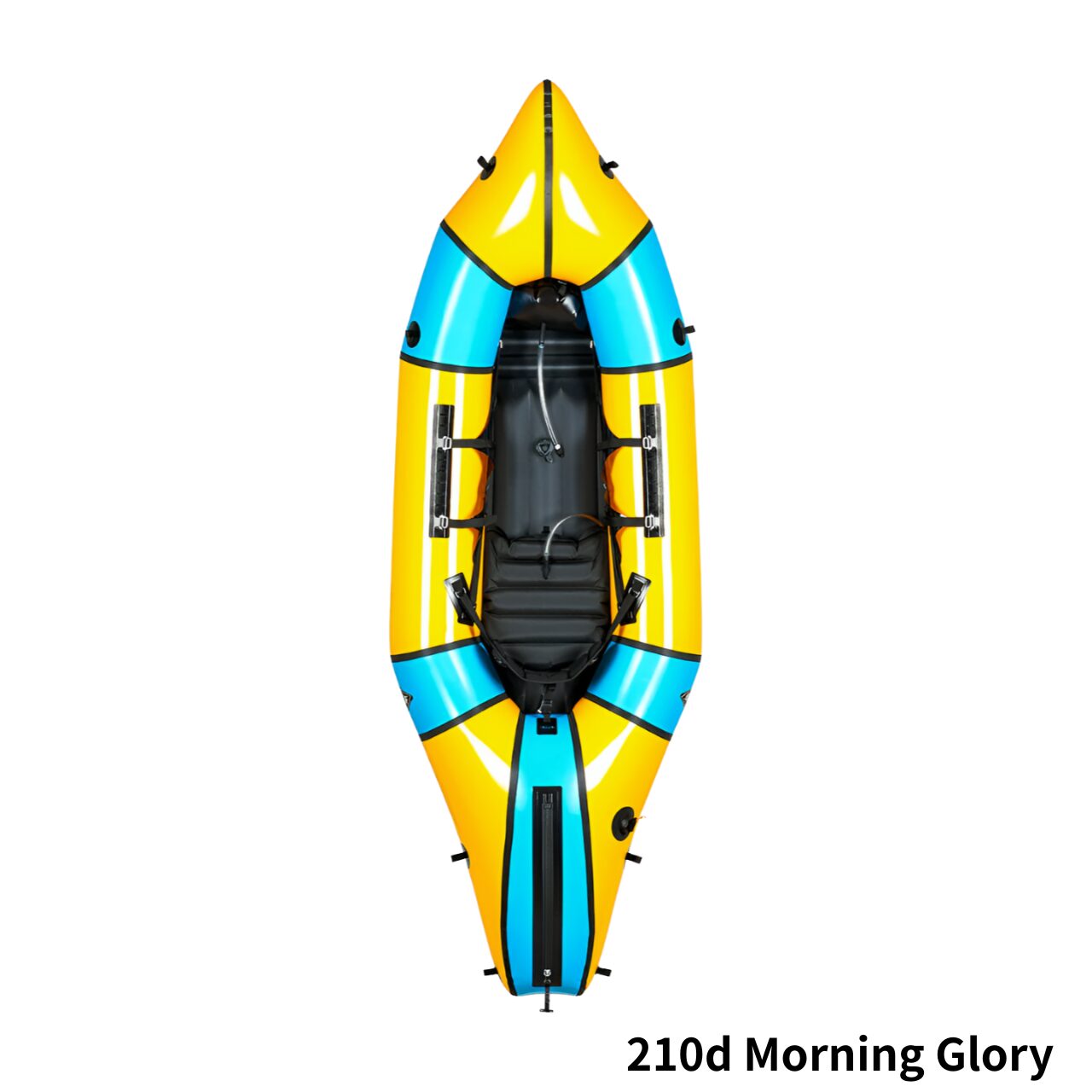
The Mage is not simply a lightweight packraft. Its performance comes from design intent, not from material reduction. Every structural element has a specific purpose — to make the boat light enough to carry anywhere and technical enough to paddle intentionally on demanding water.
Here’s how each element contributes.
- 1. Reduced Tube Diameter — A Packraft That Grips the Water
- 2. Long Waterline — A Lightweight Boat That Tracks
- 3. Sharp Bow Shape — Cutting Waves Instead of Riding Over Them
- 4. Low Deck / Low Center of Gravity — Input Transfers Directly
- 5. Light Construction — Weight That Serves Maneuverability
- 6. Load Philosophy — Optimized for Minimal Carry
- Summary
- Product Links
1. Reduced Tube Diameter — A Packraft That Grips the Water
Standard packrafts use large-diameter tubes to maximize buoyancy and initial stability. The tradeoff is that paddle input doesn’t transfer efficiently to the hull.
The Mage uses a narrower tube profile. The result: edging works; ferries hold; eddy entries stick; strokes translate to forward motion. The shift is from a boat that floats passively to a boat you actively steer. This isn’t about reducing stability — it’s about adding responsiveness.
2. Long Waterline — A Lightweight Boat That Tracks
Lightweight packrafts are typically short, which makes them spin easily but also makes them drift and slow down quickly in current.
The Mage compensates with a longer waterline. Increased contact with the water surface means: better directional stability; less deceleration between strokes; efficient forward movement with smaller paddle input; resistance to wave-induced slowdown. The result is reduced fatigue over distance, making it compatible with long-approach, technical-descent style paddling. The weight carries you; the length moves you.
3. Sharp Bow Shape — Cutting Waves Instead of Riding Over Them
A round bow lifts over waves safely but gets deflected by current in technical water, breaking off the intended line.
The Mage’s bow extends forward with a narrower profile. It parts water rather than rising above it, grips the surface, resists being pushed back, and holds ferry angles under pressure. Line reproducibility — hitting the same move consistently — improves substantially.
4. Low Deck / Low Center of Gravity — Input Transfers Directly
Higher tubes create a higher center of gravity, which makes the boat feel vague and slow to respond to edge input.
The Mage’s tube height and seat position are set lower. The boat responds proportionally to tilt: edge it and it turns; paddle and it moves. This creates a handling feel closer to a kayak — with less of the “floaty” softness typical of lightweight packrafts.
5. Light Construction — Weight That Serves Maneuverability
The Mage’s light weight serves more than the approach hike. On the water, a lighter hull means: faster acceleration; easier micro-corrections; fewer strokes needed to maintain speed; sustained concentration without fatigue. Lighter weight improves handling precision — not just packability.
6. Load Philosophy — Optimized for Minimal Carry
The Mage is not designed for large cargo. This is not a limitation — it’s a design assumption. Keeping load minimal prevents the boat from riding too high on the water, maintains surface grip, stabilizes the paddling line, and eliminates input lag. Gear selection is part of the performance equation on the Mage.
Summary
The Mage’s character comes from the balance of these six elements:
Narrow tubes → water grip. Long waterline → forward movement. Sharp bow → line control. Low center of gravity → repeatable handling. Light weight → precision. Minimal load → consistency.
Together they create a boat that is light and still technical — not a compromise between the two, but a genuine synthesis. The Mage is not a boat for drifting safely. It’s a packraft for paddling where you intend to go.
Product Links
Mage 210d Self-Bailer with Cargo Fly [2026] → Web Shop Mage 420d Self-Bailer with Cargo Fly [2026] → Web Shop Mage 210d WW Deck with Cargo Fly [2026] → Web Shop Mage 420d WW Deck with Cargo Fly [2026] → Web Shop
コメント