
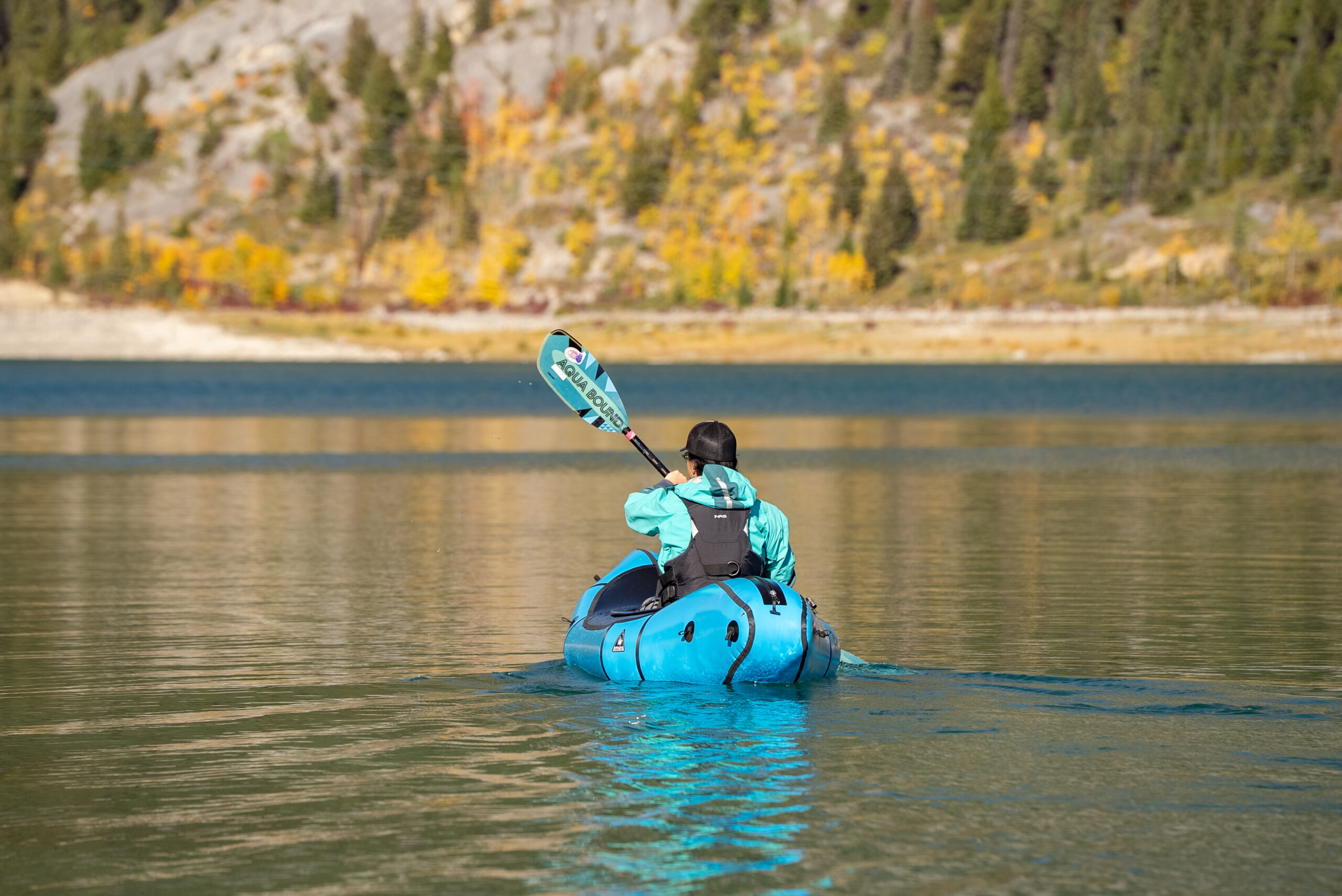
Lakes have no current. That sounds like it makes them easy. Anyone who has paddled across one knows the reality is different: headwind that stops your progress, crosswind that pushes you sideways, and distances that grow longer the further from shore you go.
Whether lake paddling is comfortable depends less on weight than on how efficiently the boat moves.
1. Straight-Line Tracking — The Core Lake Advantage
The Chinook’s 332 cm waterline length creates a clear advantage on lake crossings.
Short, rounded hulls have strong rotational response — which is useful in tight river situations, but counterproductive on open lake water. A compact packraft tends to snake with each stroke, requiring constant correction, accumulating fatigue over long distances.
The Chinook holds its heading after each stroke. The longer the crossing, the more obvious this difference becomes.
2. Crosswind Resistance — Internal Cargo Fly
Lakes can change wind direction quickly and without warning. Gear stacked high on deck catches wind and amplifies the effect of crosswinds on the hull — something common on conventional packraft setups.
The Chinook’s cargo fly allows gear to be stored inside the hull tube rather than on the deck. The practical result: less surface area exposed to wind, lower center of gravity, and a hull that holds its course in crosswind conditions better than a boat with gear mounted above.
On open water, stability is safety. Internal storage is a performance system, not a convenience feature.
3. Propulsion Efficiency — Where Lake Km Are Different
Lake paddling accumulates distance differently than river paddling. Three kilometers to the opposite shore. Five kilometers to an island and back. The energy cost of poor hull efficiency compounds directly with distance on still water.
The Chinook’s lower drag means the same effort produces more forward movement. A lake kilometer is psychologically longer than a river kilometer — the Chinook reduces that burden.
4. Multi-Lake Trips with Portages
The deeper satisfaction of lake travel often involves moving between lakes — carrying the boat across terrain to the next body of water, rather than paddling along a single shore.
The Chinook weighs approximately 4.1 kg. For a long-hull expedition packraft, this remains within realistic carrying range on a backcountry portage. Unmaintained alpine lakes, lake routes without established canoe trails, high-plateau lake traversals — the Chinook makes these possible in a way that a dedicated lake kayak cannot.
For Paddlers Who Want to Actually Cross the Lake
Day paddling along the shore suits simpler boats. But for paddlers who want to cross lakes, extend their range, have wind resistance, or carry gear on multi-day lake journeys — the Chinook is a serious option.
Lakes are calm. They are not forgiving of poor equipment choices at distance.
Choosing a boat with the right cruising performance for lake travel is the rational decision. The Chinook is one of the few packrafts that meets this standard.
Product Link
Chinook 210d Flatwater Spray Deck [2026] — One Size → Web Shop

コメント