
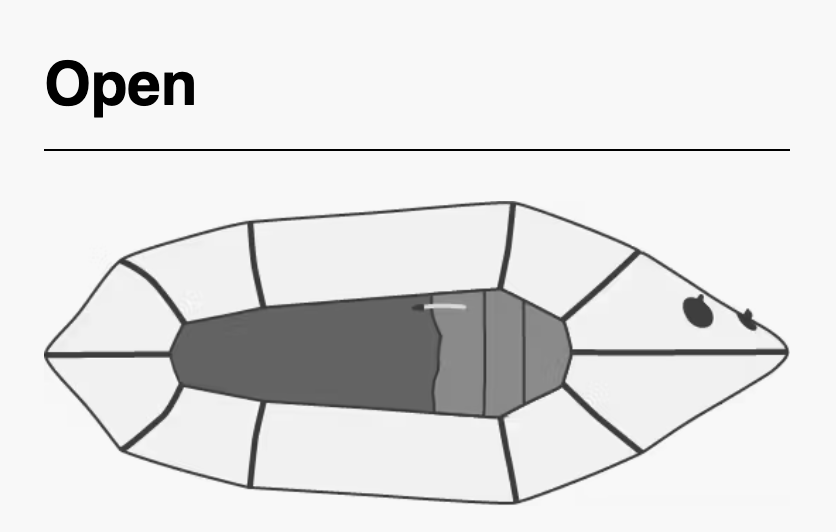
Model: AlpackaRaft Scout 210d LW Open Deck
The Scout is not a universal boat. But in the right environment, it becomes the best companion you could bring. This guide breaks down suitability by field type so you can decide where it belongs in your kit.
- 1. Lakes and Ponds — ◎ Ideal
- 2. Calm River Sections — ○ Conditional
- 3. Mountain Traverses + Lake Crossings — ◎ Exceptional Match (weather-dependent)
- 4. Bikepacking and Road Trips — ◎ Excellent
- 5. Ocean and Large Rivers — △ Conditions-Dependent
- Fields to Avoid
- Field Suitability Summary
- The Core Principle
- Product Link
1. Lakes and Ponds — ◎ Ideal
Calm, flat water is where the Scout performs at its best. Light enough to carry in, low rock-contact risk, and stable enough to enjoy unhurried paddling. Campsite lakes, alpine ponds, backcountry reservoirs, sheltered coastal coves — any still or slow-moving body of water where you want to float for a while. If your goal is simply to be on the water in a beautiful place, the Scout is the clearest possible answer.
2. Calm River Sections — ○ Conditional
Usable in slow-moving water with minimal rock exposure. Slow upper-river sections, wide stretches with good depth, calm middle reaches of larger rivers — these all work. Avoid shallow sections, continuous rapids, and rocky riverbeds. The Scout’s lightweight construction isn’t designed for the regular hull contact that comes with typical downriver paddling.
3. Mountain Traverses + Lake Crossings — ◎ Exceptional Match (weather-dependent)
This is arguably the Scout’s most compelling use case. At 1.6 kg, it adds almost nothing to a hiking pack — and transforms what would otherwise be a scenic viewpoint into a crossing you can actually make. The experience of arriving at an alpine lake and being able to launch a packraft is unique to this category of gear. The Scout makes it routine. Note: lake crossings require sound weather judgment — wind can develop quickly in open alpine terrain.
4. Bikepacking and Road Trips — ◎ Excellent
Panniers, frame bags, car boots, motorcycle luggage — the Scout fits where heavier packrafts don’t. It works as an expansion module for any trip that involves movement first and paddling as a bonus. Whenever you roll up to a lake or river, you have the option. Without the Scout, you don’t.
5. Ocean and Large Rivers — △ Conditions-Dependent
Sheltered coastal coves in calm weather: possible with appropriate caution. Wind-exposed open water: not recommended. The Scout’s light weight that makes it easy to carry also makes it responsive to wind on the water. Safety margins need to be wider than on heavier, more stable boats.
Fields to Avoid
The Scout is not appropriate for: whitewater; rock-heavy downriver routes; shallow continuous rapids; or loaded long-distance river travel.
For those uses, the Caribou or Expedition are the right tools.
Field Suitability Summary
| Field type | Suitability |
|---|---|
| Lakes | ◎ Best match |
| Alpine ponds | ◎ Excellent |
| Calm rivers | ○ Conditional |
| Bikepacking / road trips | ◎ Excellent |
| Ocean (sheltered, calm) | △ Conditions-dependent |
| Downriver paddling | ✗ |
| Whitewater | ✗ |
The Core Principle
The Scout is not a boat for pushing limits on the water. It’s a boat for expanding what’s possible on a trip. The standard isn’t difficulty — it’s packability. When the field matches, nothing else comes close.
Product Link
Scout 210d LW Open Deck [2026] → Web Shop
コメント