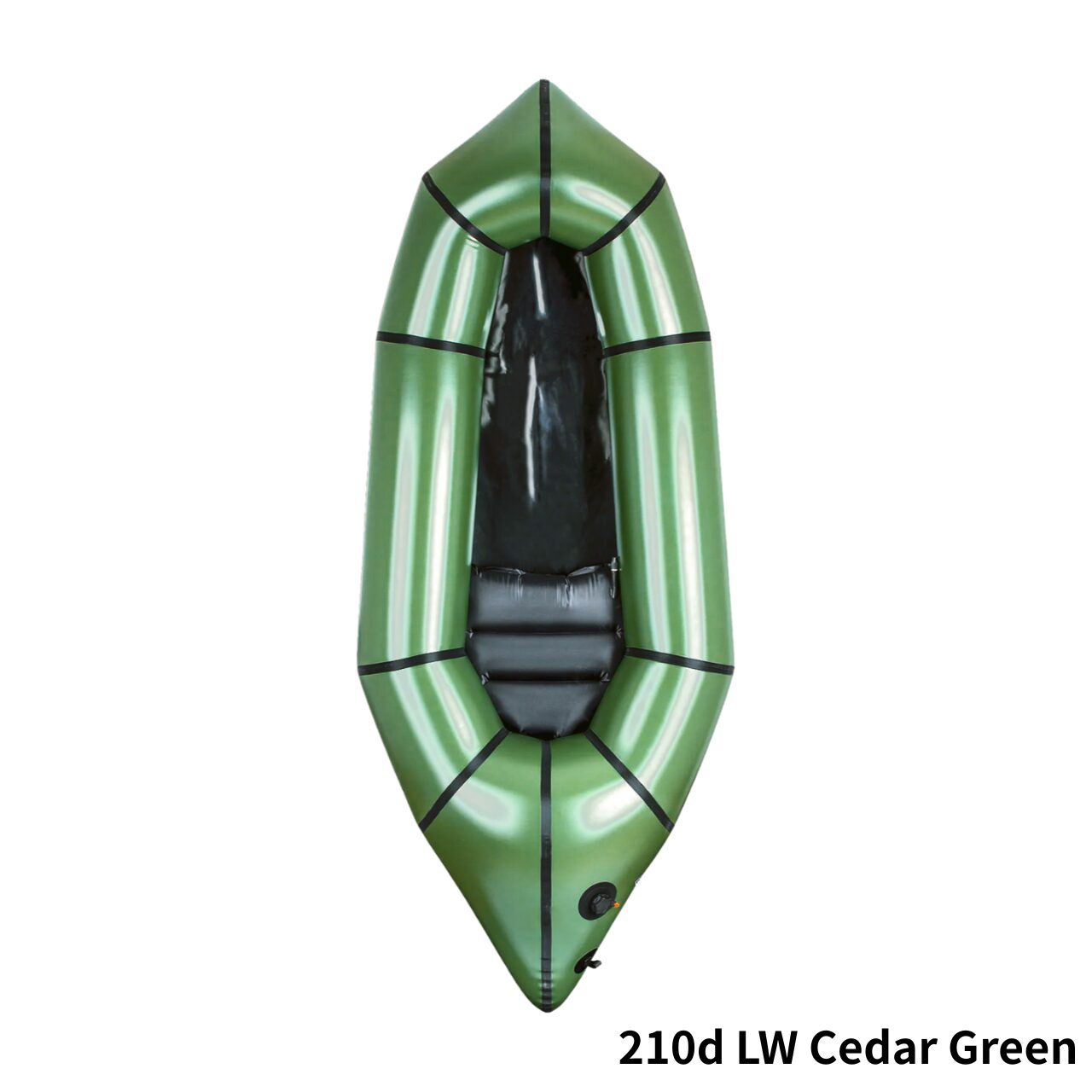
The Scout isn’t built for the trip where a packraft is essential — it’s built for the trip that gets better because one happened to come along. Ultralight, ultra-compact, and simple by design, it’s the boat that’s easy to justify bringing along on the off chance it gets used.
What the Scout Is
Kit weight is roughly 1.6kg, built from TPU-coated 210d LW nylon with a 420d nylon floor, open deck only. Compared to the Expedition, Gnarwhal, or Mage, it’s unmistakably a weight-first design.
That weight comes from a fundamentally different design premise: no whitewater deck, no cargo fly, minimal attachments — everything non-essential has been stripped away to reach 1.6kg. Basic specs run 218cm long, 86cm wide, with 116cm of interior length and 36cm of interior width (handmade, so slight unit-to-unit variation is normal). It ships with a Scout-specific seat, stern grab loop, floor seat toggle, inflation bag, stuff sack, and basic repair kit — minimal enough that inflate-and-go is the whole process.
The floor isn’t built from the heavier material meant for regular downriver impact, so it isn’t suited to frequent rock contact — a clear difference from the Caribou and Expedition, both of which use an 840d floor.
Who It’s Right For, and Who Should Look Elsewhere
Who it suits
- Anyone who wants to go as light as possible, or bring water access along on a trip that might have it
- First-time packraft buyers, lake-focused paddling
- UL-minded travelers who want the Scout as an accent to a bigger trip
Who should look elsewhere
- Paddlers wanting to run rivers. Covering distance on moving water or navigating rapids isn’t in its wheelhouse — the lightweight build offers limited rock resistance, and the floor isn’t rated for regular river impact. The Caribou or Expedition are the right tools for downriver use.
- Paddlers wanting to run whitewater. No deck, no self-bailer, no drainage. It wasn’t designed to enter turbulent water at all.
- Paddlers needing to carry real gear. The limit isn’t weight rating — it’s physical space. A large pack, multi-day food, or full bikepacking kit doesn’t fit while keeping the boat comfortable and stable. The best balance is paddler plus minimal kit.
- Larger paddlers who also want moving water. Recommended weight tops out around 90kg, with up to roughly 110kg workable on flatwater. On moving water that buoyancy margin shrinks, and the Caribou offers more buffer.
- Anyone wanting one boat for everything. Lakes, river travel, rapids, heavy loads all in a single boat isn’t what the Scout is for — it’s a weight specialist, not an all-rounder.
- Windy or open-water conditions. The same light weight that makes it easy to carry makes it vulnerable to wind. Calm, sheltered coves are fine; open ocean or wind-driven lakes aren’t recommended.
The Scout isn’t a low-performance boat — it’s a boat with a specific purpose. In the right setting there’s nothing better; in the wrong one, its limits show up quickly.
Where It Excels
The deciding factor isn’t how difficult the water is — it’s how easy the boat is to bring along.
| Field type | Suitability |
|---|---|
| Lakes / alpine ponds | ◎ |
| Calm rivers | ○ |
| Bikepacking / travel | ◎ |
| Sea (calm, good weather) | △ |
| Downriver | × |
| Whitewater | × |
Lakes and ponds (ideal) are where it performs best — light enough to carry in, low rock-contact risk, and stable enough for unhurried paddling. Campsite lakes, alpine ponds, backcountry reservoirs, sheltered coastal coves — anywhere still or slow water invites floating for a while.
Calm river sections (conditional) work when rock contact stays minimal — slow upper sections, wide stretches with good depth. Shallow sections, continuous rapids, and rocky riverbeds should be avoided; the lightweight build isn’t meant for the regular hull contact of typical downriver paddling.
Mountain traverses plus lake crossings (an exceptional match) may be the Scout’s most compelling use case. At 1.6kg it adds almost nothing to a hiking pack, and it turns what would otherwise be a scenic viewpoint into a crossing that’s actually possible. Lake crossings do call for real weather judgment — wind can build quickly in open alpine terrain.
Bikepacking and car-camping trips (ideal) benefit from how little space it needs — a bike rack, a gap in the trunk, a small pack. As an add-on to a trip built around another mode of travel, nothing lighter or more compact fills the role.
The sea and larger rivers are workable in calm, sheltered inlets when the weather holds, but wind-exposed water or chop isn’t recommended.
Sizing and Body-Type Fit
The Scout is a single-size model. There’s no size to choose — instead, the relevant question is whether build, weight, and intended use are a compatible match.
Weight: recommended up to roughly 90kg, with up to about 110kg workable on flatwater. Under 90kg is comfortable; 90–100kg is workable on flatwater but with reduced buoyancy margin, so gear should stay minimal; above 100kg the hull rides noticeably lower and handling gets heavier. On moving water, staying within the recommended weight is the safer baseline.
Height: up to 165cm leaves plenty of cockpit room with a natural knee angle and easy handling. 165–175cm is the standard, best-balanced fit. 175–183cm tends to push the knees slightly forward — fine for shorter, lightly loaded sessions. 183cm+ can feel cramped, with fatigue building faster on longer sessions; taller paddlers may find the Caribou’s cockpit more comfortable.
The more of these apply — under 80kg, under 175cm, flatwater-focused, UL-minded — the better the fit.
Load Balance
How gear gets loaded directly affects trim. Weight at the stern lifts the bow; weight at the bow lifts the stern; either way, tracking suffers. The ideal load is a small pack that fits at the feet, and heavy or bulky loads noticeably change how the boat handles. For trips needing real gear capacity, the Caribou is the better platform.
Hull volume is modest by design, optimized for calm water with a light load — a paddler plus a small amount of kit is the performance baseline this boat is built around.
How It Compares
The Refuge takes the Scout as a base and adds a whitewater deck, cargo fly, and bow grab loop — an expansion path for paddlers who find the Scout limiting. As of 2026, the Refuge is available only as a Custom Lab order.
Final Verdict
The Scout isn’t the serious-expedition boat — it’s the boat that makes travel more open-ended. It isn’t built for heavy loads; the low barrier to bringing it at all is the actual value. Being able to carry it without knowing whether it’ll get used, or strap it to a bike rack on a whim, is an experience unique to this boat. For anyone still deciding whether they need a packraft at all, the Scout is often the right answer to that question.
Related Link
→ Scout 210d LW Open Deck [2026] https://packhokkaido.base.shop/items/120269726

コメント