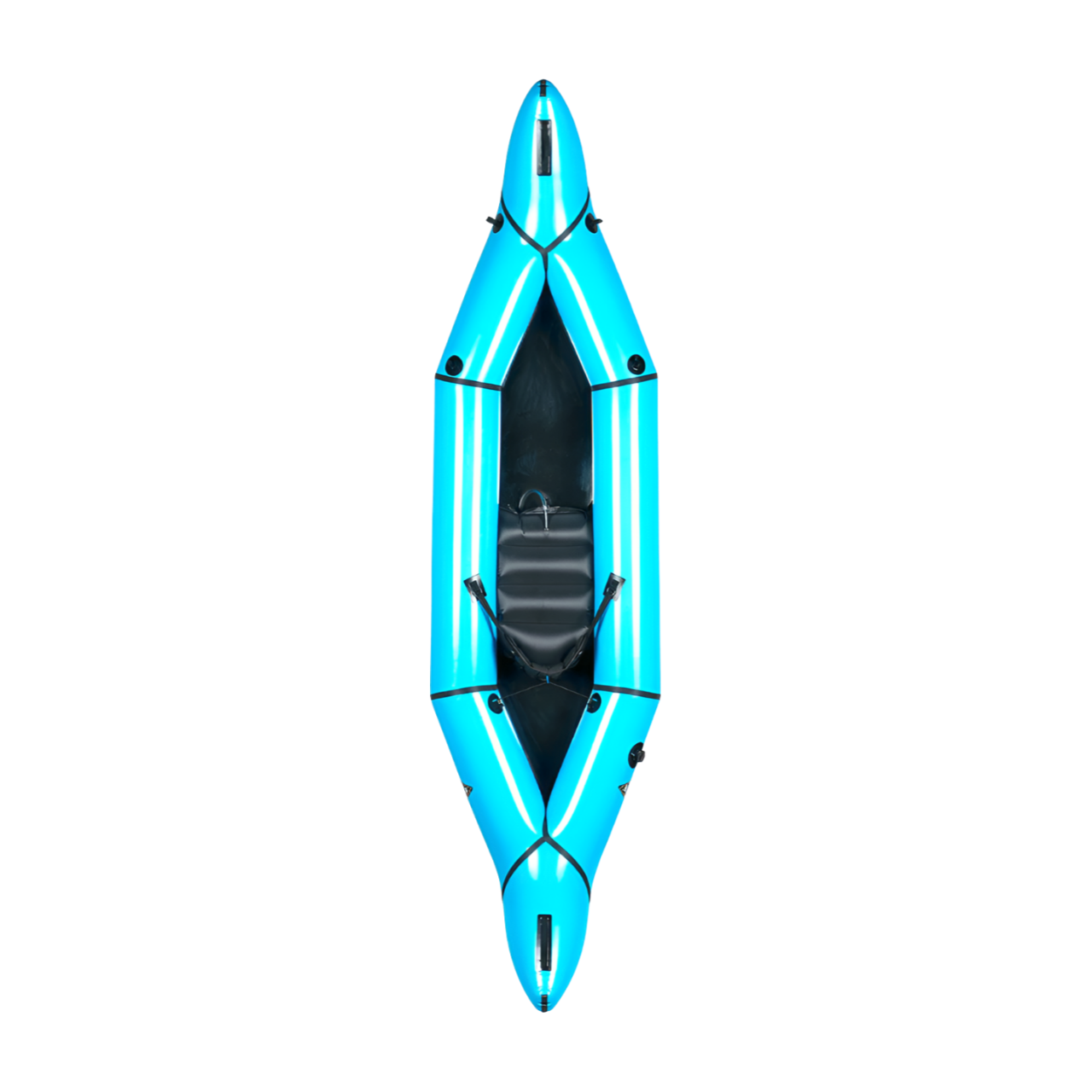
The Zephyr is best described as the recreational-kayak version of a packraft. Instead of the round hull most packrafts share, its long, slim design cuts water resistance, holds a straight line, and picks up speed easily. Where most models prioritize stability, the Zephyr prioritizes cruising performance.
What the Zephyr Is
Basic specs: 332cm long, 82.5cm wide, 36.2cm interior width, roughly 3.6kg, maximum load around 108kg. Built from 210d TPU hull fabric with an 840d floor, open deck configuration, handmade in Colorado. The proportions are tuned specifically for the balance of tracking and stability on flatwater.
Two strengths define it. It’s fast on flatwater — on lakes and lower-river sections it covers ground with fewer strokes, tracks straight, and suits an easy early-morning paddle. It has a noticeably stronger sense of forward motion than a round-hull design. It’s built around travel — the whole concept is paddling casually while traveling, and that shows in duffel-bag packability, flying with it, and needing neither a roof rack nor garage storage. It solves the mobility problem of a heavy recreational kayak while keeping the same basic form factor.
Who It’s Right For
The Zephyr is genuinely easy to handle for most beginners, provided the field it’s used on is understood — with that in place, it’s a rational choice as a first packraft.
Three things make it beginner-friendly. High tracking stability — the slim, long hull holds a line well, which covers for the inconsistent paddling form most beginners start with. Efficient forward progress — the long hull meets less resistance, so fewer strokes move it further, and it moves along briskly even without much arm strength. Flatwater-only use removes most of the fear — since it’s designed for lakes and calm rivers, the usual worries for new paddlers, like hitting rocks, getting pushed by current, or facing big waves, mostly don’t come up. The simple open-deck setup also means there’s little to fumble with, which matters more than it sounds for keeping a first outing fun.
It suits paddlers who want to enjoy calm lakes or rivers, paddle somewhere while traveling, avoid hauling a heavy kayak, or want a companion piece of gear for van life or bikepacking. It isn’t built for whitewater, and choosing it with a river-running mindset in mind is a mismatch. Windy days call for caution even on flatwater, since chop picks up and handling gets heavier — knowing when to turn back matters. Overloading it with gear also degrades buoyancy and tracking, so it isn’t suited to heavily loaded long trips either.
Where It Excels
Lakes come first, and it is the best match here. On a calm early morning, with the surface sitting still, the boat does exactly what it was designed to do. Good tracking and an easy launch mean each stroke actually carries the boat forward, more so than a round-hull packraft manages. A lake next to a campground works just as well, paddled briefly at dawn or dusk. Wind is the exception: a crosswind is noticeable, and a large lake with real waves is not a good match for this hull.
② Calm, flat rivers. Lower sections, wide slow-moving rivers, and calm stretches behind a weir all work well. Driving up to a put-in, floating a simple downriver stretch, and taking out downstream lets the longer hull carry momentum with the current, easing on effort while the scenery does the work. This suits river travel with essentially no rapids, below Class I — not sections with continuous rapids or technical rock gardens, where the Caribou or Gnarwhal are the safer choice.
③ Travel activity boat — where it’s genuinely unique. Packed into a suitcase, loaded into a rental car, paddled as part of sightseeing — bringing a recreational kayak on a flight isn’t realistic, but the Zephyr makes that possible. For anyone who wants to add time on the water to a trip to Hokkaido, Okinawa, or a protected bay overseas, it’s a strong option. It also fits naturally into a van-life trip built around RV parks, roadside stations, or lakeside campgrounds without getting in the way.
④ Bikepacking plus flatwater. At roughly 3.6kg it isn’t among the lightest packrafts, but paired with a mountain bike or gravel bike it becomes a realistic addition — a lake cruise or reservoir exploration layered onto a bike trip. Loading it onto a bike does take some practice.
What to avoid: open ocean and coastal passages, large windy lakes, whitewater, and multi-day river trips with heavy gear. The Zephyr is a deliberately narrow-purpose boat — not a do-everything design, but one that reaches a high level of polish by specializing in flatwater and travel.
Sizing and Body-Type Fit
The Zephyr comes in one size. There’s no sizing decision to make — what matters instead is whether build, weight, and gear load line up with what this boat is built around.
Fit by build: up to about 160cm gets light handling with room at the feet and a reassuring closeness to the water. 160–175cm is the sweet spot the design is built around, with a strong connection from thighs to seat and a good balance of stability and handling — the range that stays comfortable over long flatwater sessions. 175–185cm pushes the feet slightly forward, but not to a problematic degree, and stays comfortable across most fields.
Weight and float: maximum load is around 108kg. Up to about 80kg paddles comfortably with margin to spare. 80–100kg still works, but margin shrinks once gear is added, so keeping the load light matters. Past 100kg, buoyancy margin narrows and handling gets noticeably heavier. Think in terms of paddler weight plus gear combined, not gear alone.
Improving the fit: as an open boat, it ships without a foot brace, but a Hybrid Bow Bag Liner or Lap Bag positioned at the feet substitutes well — stable footing meaningfully improves paddling efficiency. A foam back band that stabilizes upper-body posture also cuts fatigue significantly over a long session.
The Zephyr performs best for a 160–175cm paddler under roughly 90kg, running light gear, mostly on flatwater. Outside that range it still works, but expect to manage gear, posture, and buoyancy more deliberately. For heavy loads or whitewater, another model is worth considering.
Load Capacity and Packing
The Zephyr is slim, long, light, and flatwater-oriented — in one line, a light-to-moderate load model.
| Load | Comfort |
|---|---|
| Up to 8kg | Excellent |
| 8–12kg | Practical range |
| 12–15kg | Noticeably heavy |
| 15kg+ | Not recommended |
Day lake touring sits around 5 to 8kg and is the best match for this boat. A 20L dry bag, wind shell, rain jacket, snacks, a 1L bottle, a small camera, and a basic first aid kit all fit within that range comfortably, with trim staying balanced and barely any speed penalty. This is the Zephyr running exactly as it was built to.
Light one-night touring (8–12kg): add a lightweight tent, down sleeping bag, sleeping pad, cookpot, and a day of food. The waterline drops slightly but tracking holds. This is the practical ceiling for comfortable touring — keeping gear light matters here.
Photography touring (around 10kg): a mirrorless or DSLR body, waterproof case, lightweight tripod, and an extra lens. Keep heavy items centered and balanced left-right. The tracking stability that defines this hull makes it a solid platform for composing shots mid-paddle.
Heavy camping load (15kg+, not recommended): a 40L+ bag, extra food, and campfire gear push it into this range. The hull sits noticeably lower, turning gets sluggish, and wind and small waves start to matter more. This sits outside the Zephyr’s design intent — the Caribou or Expedition are better suited to full camping kit.
Three packing rules: keep heavy items centered (loading the bow causes bow sink and tracking problems), keep the load low (stacking gear high raises the center of gravity), and keep left-right balance (asymmetric loads pull the hull off-line). For a paddler around 60kg, up to 10kg of gear still feels comfortable; at 75kg+, anything over 10kg becomes noticeable in handling.
How It Compares
vs Chinook. The Chinook takes the same hull and adds a spray deck and cargo fly for multi-day expedition use. The Zephyr strips that same hull down to essentials — a deliberately simplified, day-trip-and-travel-focused boat.
vs Aleutian. The Aleutian is built around sea-kayak thinking for open, rough coastal water. The Zephyr is limited to protected water — a genuinely different category of use.
vs Caribou. The Caribou is the generalist, covering both lakes and rivers. The Zephyr is the speed-focused specialist for flatwater day trips. Choose the Zephyr for flatwater day use, the Caribou for versatility.
vs Expedition. The Zephyr suits day trips and travel; the Expedition is the serious, multi-day, cold-weather-capable expedition boat. The scale of the trip makes the choice clear.
Quick decision guide: paddling while traveling → Zephyr. Wanting rivers too, with stability as the priority → Caribou. Technical whitewater fun → Gnarwhal. Long-distance, multi-day, pack-first travel → Expedition. High-performance whitewater handling → Mage.
Before Buying, and the Final Verdict
A Pack-A-Pump is worth using. The Zephyr needs a high working pressure, and keeping it properly inflated prevents wrinkling in the hull and lets its tracking performance show up fully. Alpacka’s own high-pressure pump connects directly to the valve for this.
The balance of light weight and real performance is a strong selling point — roughly 3.6kg means loading it into a car, flying with it, and storing it alongside camping gear all happen without a fight. There’s no roof rack to deal with and no dedicated storage space to find.
The Zephyr isn’t just a piece of equipment — it’s what makes it possible to travel light and head for the water on a whim, once the usual hassle of a heavy boat is out of the picture. If whitewater is the main goal, or the plan involves long trips with heavy gear, the Gnarwhal, Caribou, or Expedition are worth considering instead.
Related Link
→ Zephyr 210d Open Deck, One Size [2026] https://packhokkaido.base.shop/items/130659426

Comments