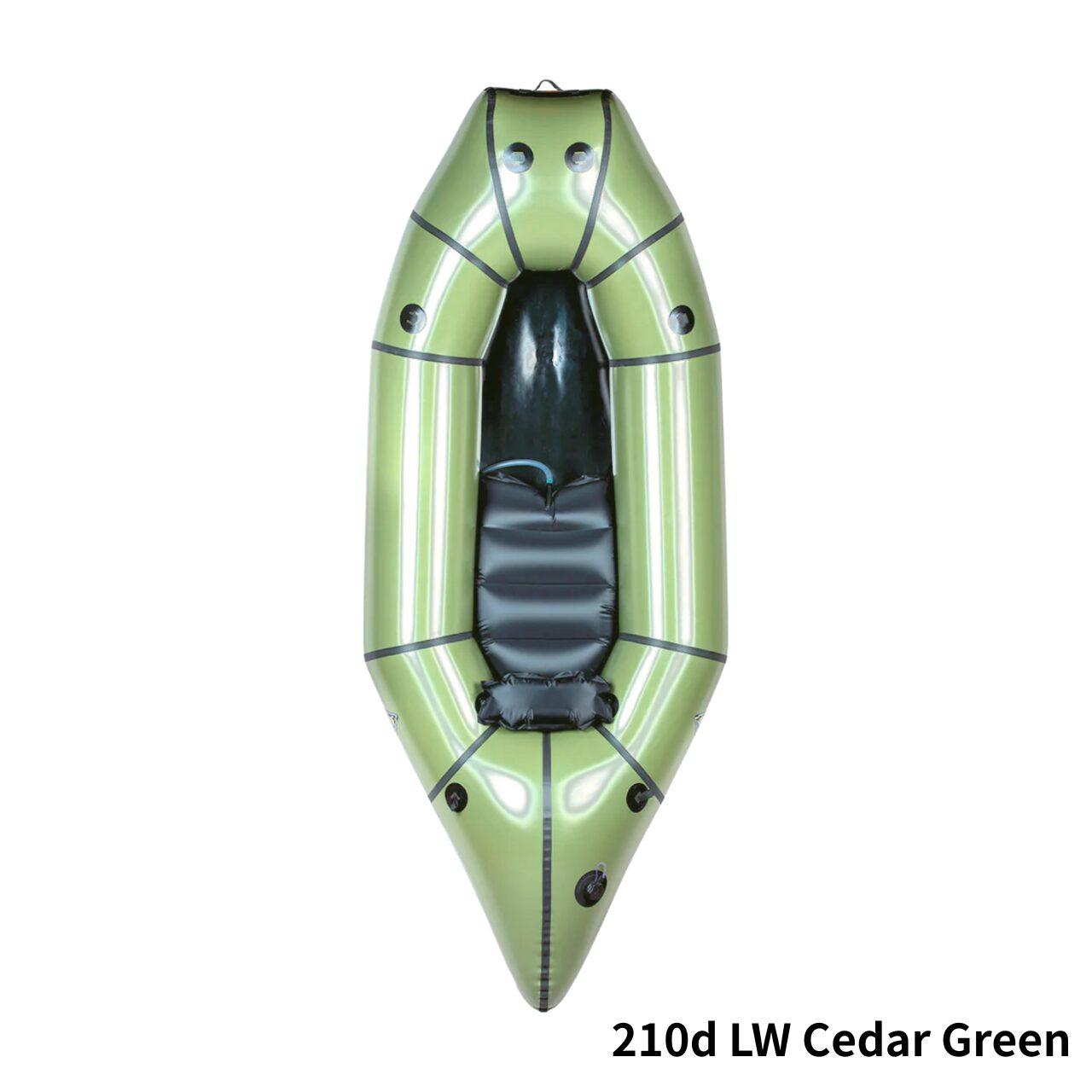
The Alpacka Raft Caribou comes in several deck configurations, and the open deck stands out for one reason above all: simplicity and weight savings. But before buying, the questions that always come up are — how far can it actually go? What happens when a wave hits? Is it okay for river paddling?
This article maps out the Caribou open deck’s real-world range and limits, organized by field type.
At a Glance: What the Open Deck Handles
Handles well (◎): Lakes and still water; reservoirs; calm rivers with light flow (lightwater); backpacking-approach trips; bikepacking.
Workable with care (△): Small, avoidable rapids; calm sections near still water.
Not well-suited (×): Continuous whitewater; rivers with strong sustained current; lakes with significant wind-driven chop.
The open deck is a strong tool for lightweight access to flat and light-moving water — and a poor fit for high-energy environments where waves or current dominate.
Why the Open Deck Wins on Weight
The open deck eliminates drainage mechanisms and deck material — it’s the most stripped-down configuration possible. The result: lower total weight, better packability, faster setup, and fewer parts to worry about. For long hike-and-paddle days, bike-plus-water trips, or anyone starting out and wanting simplicity first, weight is the biggest advantage.
Where the Open Deck Performs Naturally
Still water and lakes. The Caribou is designed as a lightweight adventure model balancing load capacity with packability. On calm water, waves are minimal, water stays out, and the light hull makes long cruises less tiring. Mountain lake approaches — especially by foot or bike — are exactly where the open deck shines.
Calm rivers (lightwater). On rivers with gentle flow, scattered minor shallows, and few hazards that can’t be read and avoided, the open deck manages well. Feet stay drier, handling is straightforward, and loaded cargo stays balanced. The key is reading the river and choosing lines that avoid the worst of the water, not pushing into conditions the boat isn’t designed for.
Where the Open Deck Reaches Its Limits
Continuous whitewater. Where rapids follow each other in sequence or waves pile up regularly, water accumulates in the cockpit and has nowhere to go. Feet stay wet, fatigue builds faster, and the paddling becomes less safe and less comfortable. A self-bailer or WW deck is substantially better here.
Wind-chop on lakes. Open water with wind-driven chop introduces instability, easier water ingress, and sustained cold at the feet — a combination that erodes open-deck comfort quickly.
Cold Conditions: Usable with the Right Gear
Cold-season paddling on lakes or calm rivers with an open deck is possible — but it requires commitment to the gear side. A drysuit or dry pants, neoprene socks or boots, and keeping sessions purposeful rather than prolonged all help significantly. In extreme cold water or all-day wave exposure, thermal management is non-negotiable.
Who the Open Deck Is Right For
The open deck suits you well if you prioritize light weight and simplicity; paddle mainly lakes and calm rivers; want a bikepacking-compatible setup; are choosing your first packraft; or are planning loaded touring with lots of gear.
When the Self-Bailer Makes More Sense
Choose the self-bailer if there’s meaningful risk of taking on water; your focus is downriver paddling; or fast re-entry after a swim matters to you.
Summary
What the Caribou open deck handles: lakes, still water, calm rivers, long touring, bikepacking.
Where it needs care: continuous rapids, high-wave lakes, extended cold-water immersion.
The Caribou open deck is not a universal tool — but understood on its own terms, it’s an excellent one. Match it to the right field and it delivers low-stress, high-range, lightweight water access.
Product Links
Caribou LW210d Open Deck [2026] → Web Shop Caribou STD210d Open Deck [2026] → Web Shop Caribou LW210d Self-Bailer with Cargo Fly [2026] → Web Shop Caribou STD210d Self-Bailer with Cargo Fly [2026] → Web Shop
コメント