
Maintenance information for packrafts is still fairly limited — even the official guidance from Alpacka Raft is only available in English on their website, which means many owners haven’t had a chance to read it carefully. This article covers the essentials: general care, home cleaning and storage, and detailed cargo fly zipper maintenance.
Alpacka Raft’s Approach to Maintenance
Alpacka Raft describes their boats this way on their website: packrafts are designed for hard use and require very little maintenance. The goal has always been to build a boat that doesn’t demand much attention on the water or off it. With proper preventive care, however, a packraft can stay in excellent condition and last significantly longer.
This is backed up by real-world evidence — Alpacka Rafts from over a decade ago are still in active use. Part of the reason is the panel bonding method used in construction, and part is simply that packrafts operate at much lower air pressure than SUPs and similar inflatables, which reduces stress on the seams over time.
On-River Maintenance
Outside of cargo fly zipper care, there’s very little you need to do to keep a packraft in good condition while you’re out on the water. The main thing to watch: keep sand, dirt, and debris out of the cargo fly zipper. For the main body of the boat, the primary concern is avoiding excessive friction — for example, when the packraft is strapped to a backpack or a bicycle frame. Abrasion from sustained contact can wear the outer coating over time.
Cleaning and Storage at Home
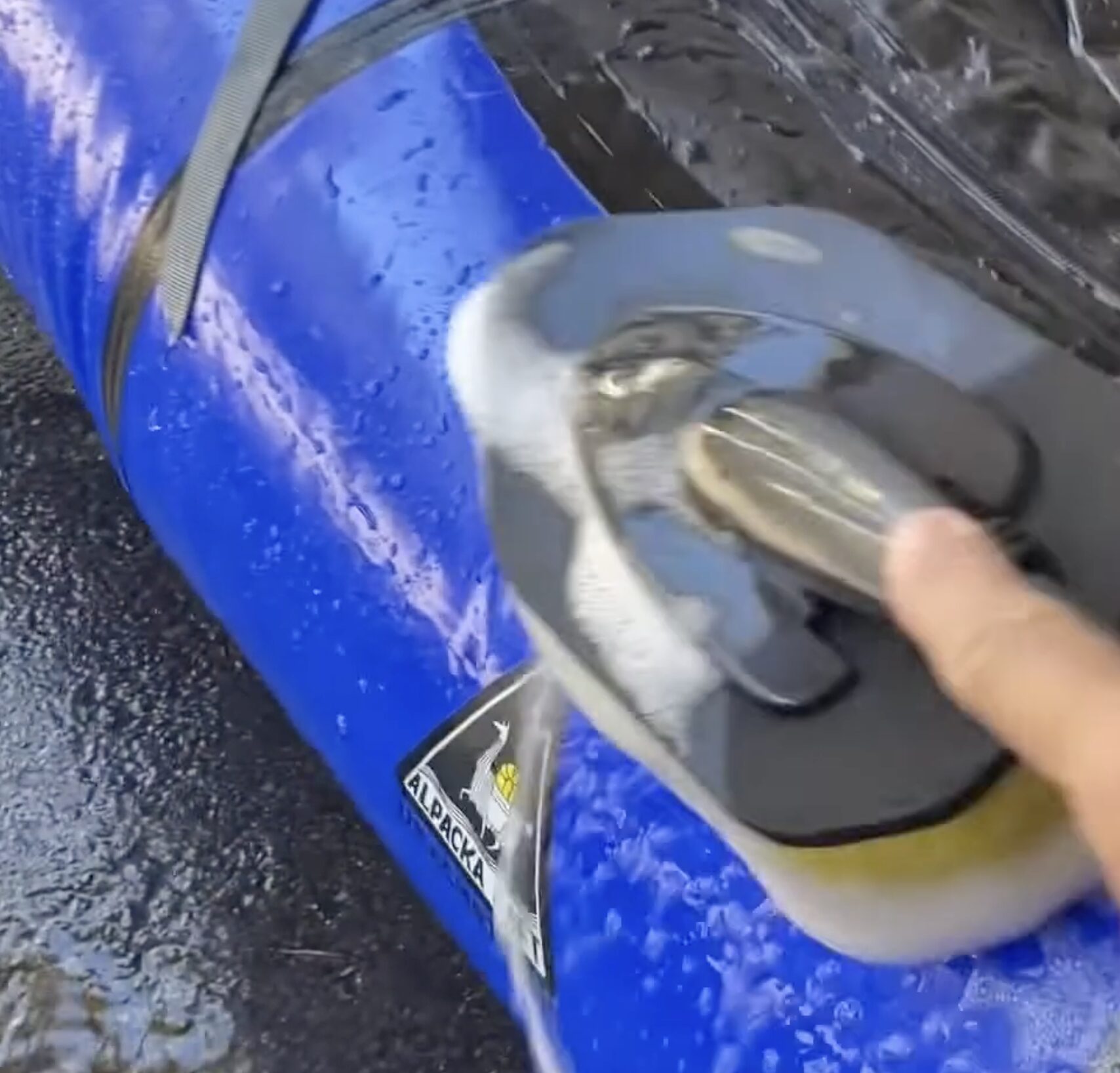
Keep it clean. Washing with a mild neutral soap removes river residue and helps prevent the spread of invasive species via river water.
Dry it completely before storing. Storing a wet packraft can damage the cargo fly zipper and — importantly — lead to a strong ammonia-like odor that becomes very difficult to remove. After every trip, hang the packraft and let it air dry fully before putting it away.
Store it properly. After drying, keep the packraft in a cool, ventilated, dry location out of direct sunlight. Hanging it, rolling it loosely, or folding it gently are all fine. Do not store it compressed in a stuff sack — tight packing over time can cause discoloration and stress the material. UV exposure degrades the fabric, so avoid leaving it in direct sunlight for extended periods.
Inspect it regularly. After any period of storage, after use in unusual ways (as a tarp, for hauling gear, etc.), or any time you suspect the boat may have been damaged, check it over carefully before your next paddle.
Do not apply UV protectant sprays. These products create a hard outer coating that prevents repair materials and adhesives from bonding to the surface. If a UV spray has been accidentally applied, the effect fades over time — but until it does, field repairs and adding attachment points will be unreliable.
The simple routine to remember: wash → inflate and air dry → loosely roll → store in a cool, shaded, ventilated space.
I personally wash not just the outer tubes but also the interior of the cockpit after each trip.
Cargo Fly Zipper Maintenance
The cargo fly is the T-ZIP waterproof zipper system on the stern of cargo-equipped packrafts, allowing gear to be stored inside the boat. It’s one of the most convenient features on a packraft — and also the one that demands the most consistent care.
Alpacka Raft’s guidance is clear: the cargo fly zipper needs to be cleaned, dried, and lubricated after every trip, and frequently in the field. Neglecting this causes gradual deterioration, eventually leading to the zipper failing to seal — and air leaking from the boat. Speaking directly with Alpacka Raft’s global sales team, I was told: cargo fly zipper repair and replacement is expensive. Please maintain it consistently.
The good news: the entire process comes down to three steps — clean, dry, lubricate — and none of them are difficult.
For a visual reference, Alpacka Raft has a maintenance video on Vimeo (in English, but the technique is easy to follow visually).
What You’ll Need
A small clean cloth (cut from an old t-shirt works well — make a fresh piece each time), zipper lubricant, and a small brush. An old toothbrush is ideal as a zipper brush. Keep a field maintenance kit with you and service the zipper as frequently as possible during trips.
How to Clean the Cargo Fly Zipper
If the zipper isn’t closing smoothly, sand or grit in the zipper chain is almost always the cause. Keep the chain free of sand, dirt, and debris. Note that lubricant has a sticky quality that attracts particles — do not apply lubricant directly to the zipper chain. To clean, first work through with a small brush. For more stubborn cleaning, use warm soapy water.
Step-by-Step Lubrication
- With the zipper closed, apply lubricant to a cloth and use the cloth to work the lubricant into the outer urethane-laminated surface of the zipper. Do not apply lubricant directly to the zipper teeth.
- Continue until the entire outer surface of the closed zipper is evenly covered.
- Wipe off any excess lubricant — residue left on the surface will attract dirt and sand, which defeats the purpose.
- Open the zipper and use the cloth to apply a light coat of lubricant to the chain and sealing edges.
- Apply a small amount of lubricant to the docking end of the zipper.
- Open and close the zipper several times — it should now slide smoothly and close easily.
Repeat as needed. The goal is a consistently thin, even coat of lubricant along the length of the zipper, allowing the slider head to move freely and the zipper to close completely without force.
Storage Notes for Cargo Fly Zippers
After every use, leave the zipper open to allow it to dry completely, then close it for storage. Storing a wet zipper can cause it to rot or crack. If you need to transport a wet packraft home, orient it so the cargo fly side faces outward for airflow.
A practical tip for packing up after a trip: many paddlers roll their packraft with the floor side out. If you have a cargo fly model, try rolling from the bow with the floor side in and the cargo fly side out — this naturally keeps the zipper exposed to airflow during transport.
Cargo Fly Zipper Troubleshooting
Zipper separating behind the slider head: If the zipper opens behind the head, pull the slider back past the separated section and re-close. You may need to clean and lubricate first. If needed, use your fingers to press the zipper closed in the problem area before running the slider through again.
Zipper coming apart at the base: Clean the base area thoroughly, then manually press the first 3cm of zipper teeth together by hand before reinserting the slider head and running it through.
Small gap remaining at the base after closing: This is usually caused by debris jamming the teeth at the base. Manually separate the zipper at that point, clean the area, then follow the steps above to re-close.
If a cargo fly problem occurs in the field, it can feel alarming — potentially meaning you can’t inflate the boat. Stay calm, work through these steps methodically, and you’ll usually be able to resolve it. Consistent maintenance is what prevents it from getting to that point. Take care of your packraft and it will take care of you.

コメント