
What do you need to bring on a packraft river trip?
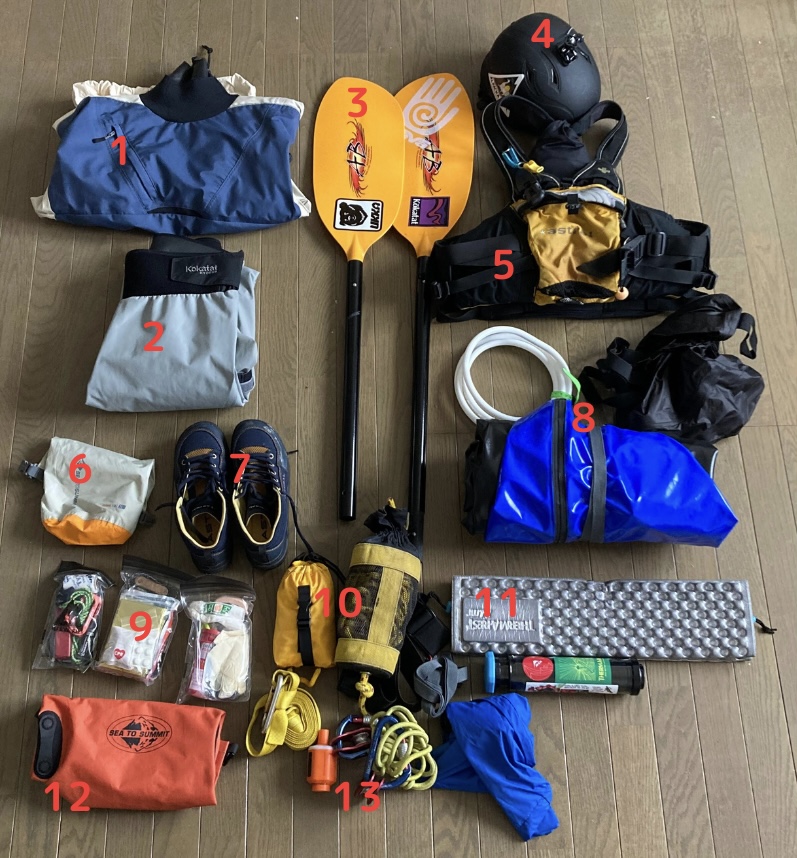
Once you have the boat, the next question is everything else. This article walks through the 13 core items I bring on every river trip — what each one is, why I chose it, and what to look for when making your own selection.
One important note upfront: Hokkaido’s water temperatures stay cold year-round, even when air temperatures rise in summer. Some of the gear choices here — particularly drywear — reflect that reality. If you’re paddling in warmer climates, adjust accordingly.
- Quick Reference — Essential Gear at a Glance
- 1. Dry Top — Kokatat Hydrus 3.0
- 2. Dry Pants — Kokatat Hydrus 3.0
- 3. Paddle — Aquabound Shred, Fiberglass Shaft / Nylon Blade, 4-Piece
- 4. Helmet — Sweet Protection Wanderer 2
- 5. PFD — Astral Aquavest 300 + River Knife + Whistle
- 6. Dry Bag (Small) — Sea to Summit eVac
- 7. Water Shoes — Astral Rassler 2.0
- 8. Packraft — Alpacka Raft Classic, Size M, WR Deck
- 9. Repair Kit + First Aid Kit
- 10. Throw Bags — Shuugakuso Mini + Mont-bell 15m
- 11. Therm-a-Rest Z Lite SOL (No longer in kit)
- 12. Dry Bag (Large) — Sea to Summit Big River, 13L
- 13. Webbing, Pulley, Carabiners, Pumps
- Related Articles
Quick Reference — Essential Gear at a Glance
| Category | Item | Priority |
|---|---|---|
| Drywear | Dry top + dry pants (or full drysuit) | ◎ Essential |
| Paddle | 4-piece paddle | ◎ Essential |
| Safety | PFD, helmet, river knife, whistle | ◎ Essential |
| Rescue | Throw bag (one per person) | ◎ Essential |
| Boat | Packraft | ◎ Essential |
| Footwear | Water shoes or secure sandals | ◎ Essential |
| Storage | Dry bags (large + small) | ◎ Essential |
| Emergency | Repair kit + first aid kit | ◎ Essential |
| Auxiliary | Webbing, carabiners, pump | ○ Recommended |
1. Dry Top — Kokatat Hydrus 3.0
In Hokkaido, the window for paddling without a dry top or full drysuit is extremely short. Water temperatures stay cold throughout the year regardless of the season, so thermal protection isn’t optional — it’s baseline.
The approach I use: the dry top handles water exposure; mid-layer adjustments underneath handle air temperature changes. This gives you flexibility across a range of conditions without needing multiple outer layers.range.
2. Dry Pants — Kokatat Hydrus 3.0
Same reasoning as the dry top. A full one-piece drysuit provides better waterproofing overall, but I use a two-piece (separate top and pants) for one practical reason: when the fabric eventually degrades and starts leaking — which happens to all drysuits over time — you can replace only the piece that’s worn out rather than the whole suit.
Choose based on your budget and how often you paddle. For high-frequency use in cold water, a full drysuit is worth the investment.
3. Paddle — Aquabound Shred, Fiberglass Shaft / Nylon Blade, 4-Piece
I don’t chase ultralight paddle weight, but build quality matters to me — no play in the joints, solid lock-up in every configuration. A paddle that rattles or shifts mid-stroke is a distraction on moving water.
On the 4-piece format: if you’re driving to your put-in and leaving the car nearby, a 2-piece paddle works perfectly well. But if you’re packing in on foot — which is often the point of packrafting — a 4-piece paddle that fits inside or alongside your pack is the natural choice.
→ Related: 4-Piece Kayak Paddle vs Packraft Paddle
4. Helmet — Sweet Protection Wanderer 2
Fit is the top priority. A helmet that shifts on impact isn’t protecting you — it just looks like it is. Try before you buy.
Some packrafters use a bike helmet or mountaineering helmet, and in some contexts that’s workable. What dedicated kayak helmets offer that others don’t: interior padding that doesn’t absorb and retain water, and a shell designed to handle hard rock impacts. On moving water, those properties are worth having.
5. PFD — Astral Aquavest 300 + River Knife + Whistle
For river use, a whitewater-rated PFD is the right choice. Aerated whitewater — the white, foamy sections — is less buoyant than flat water, so a PFD rated for those conditions matters. Standards to look for:
- Adults: minimum 7.5kg buoyancy
- Children: minimum 5kg buoyancy
- US Coast Guard certification, or Japan’s Sakura Mark
Fit is as important as rating. A correctly rated PFD that doesn’t fit properly provides little real protection. Try it on with the layers you’d actually wear on the river.
Always attached to the PFD:
River knife (serrated blade): If you end up entangled in rope underwater, a serrated blade cuts through efficiently where a straight blade struggles. This is non-negotiable kit for anyone on moving water.
Pealess whistle:
Voices don’t carry well on rivers — wind, current, and distance all work against you. A whistle is how you communicate at range. Pealess designs work when wet; FOX40 is widely used in the paddling community.
(Note: I replaced this PFD in 2024 due to age-related buoyancy degradation.)
6. Dry Bag (Small) — Sea to Summit eVac
This is where my repair kit and first aid kit live — the two things that absolutely cannot get wet. On the river, assume anything not in a dry bag will eventually get wet. Plan accordingly.
7. Water Shoes — Astral Rassler 2.0
Viable options include water shoes, heel-strapped sandals that won’t come off in current, or trail runners you don’t mind soaking. What matters most:
Traction: Wet rock is surprisingly slippery. Footwear not designed for wet conditions can be genuinely dangerous on the river approaches and exits.
Trail compatibility: If your packrafting involves hiking approaches — common in Hokkaido — you need footwear that handles both. The Rassler 2.0 covers both reasonably well, which is why it became my go-to.
→ Related: The Search for Packrafting Shoes / Continued
8. Packraft — Alpacka Raft Classic, Size M, WR Deck
Alpacka Raft is the company that originated the packraft as a product category — based in Mancos, Colorado, USA. The Classic is their all-rounder: equally at home on mellow river touring and more technical whitewater.
“All-rounder” sometimes implies compromise. The Classic earns its reputation by being a genuinely high-performance boat that happens to be versatile — carrying the core DNA of what a packraft should be without sacrificing it for breadth.
9. Repair Kit + First Aid Kit
A repair kit for on-river packraft fixes; two first aid kits for injuries. Both are sealed in LOKSAK waterproof bags, then stored together inside item 6 (the eVac dry bag). A dedicated post on the contents of each is planned.ach.
10. Throw Bags — Shuugakuso Mini + Mont-bell 15m
Every paddler in the group carries their own throw bag. This is personal rescue equipment, not shared group gear. Without one, reaching a swimmer in moving current can be extremely difficult or impossible.
The Shuugakuso (Hokkaido outdoor retailer) mini throw bag is compact and light enough to carry easily on a packraft, and quick to deploy — even for paddlers without a lot of upper body strength. Good for paddlers of any size.
The Mont-bell 15m throw bag serves as backup and extends reach when the mini bag’s rope length isn’t enough.
11. Therm-a-Rest Z Lite SOL (No longer in kit)
Originally used as a cockpit floor pad for insulation and protection. I’ve since decided the weight penalty isn’t worth it and removed it from my setup. Listed here for reference only.
12. Dry Bag (Large) — Sea to Summit Big River, 13L
This organizes items 9 (repair and first aid kits), carabiners, and miscellaneous small items. During river trips, it sits at my feet and doubles as a foot brace — keeping my legs braced against the cockpit for better boat control. Dual-purpose use that helps keep overall kit weight down.
13. Webbing, Pulley, Carabiners, Pumps
Webbing: Multi-purpose — tethering the packraft to shore, creating anchors, improvising a harness in a pinch.
Pulley + locking carabiners: Not strictly essential (a carabiner can substitute for a pulley), but together they enable a mechanical advantage system useful in extractions and rescue situations. Locking carabiners are also standard kit for rope-based rescue systems.
Electric pump + inflation bag: Part of the inflation setup.
AlpackaRaft Pack-A-Pump: A compact manual pump worth having for any Alpacka owner. Ideal for topping off pressure before launching, or re-inflating after the packraft contracts in cold river water. Small enough that carrying it costs almost nothing.
Related Articles
- Packraft Spray Skirt Guide — IR Sixmile Skirt Explained
- Packraft Maintenance Guide
- 4-Piece Kayak Paddle vs Packraft Paddle
- The Search for Packrafting Shoes
コメント