Summers in Hokkaido have been getting genuinely hot in recent years. Outside of the colder months when a socketed full drysuit or dry pants are the obvious choice, warmer conditions open up lighter clothing options for paddling. (Rescue scenarios still need to inform your layering decisions — always worth keeping that in mind.)
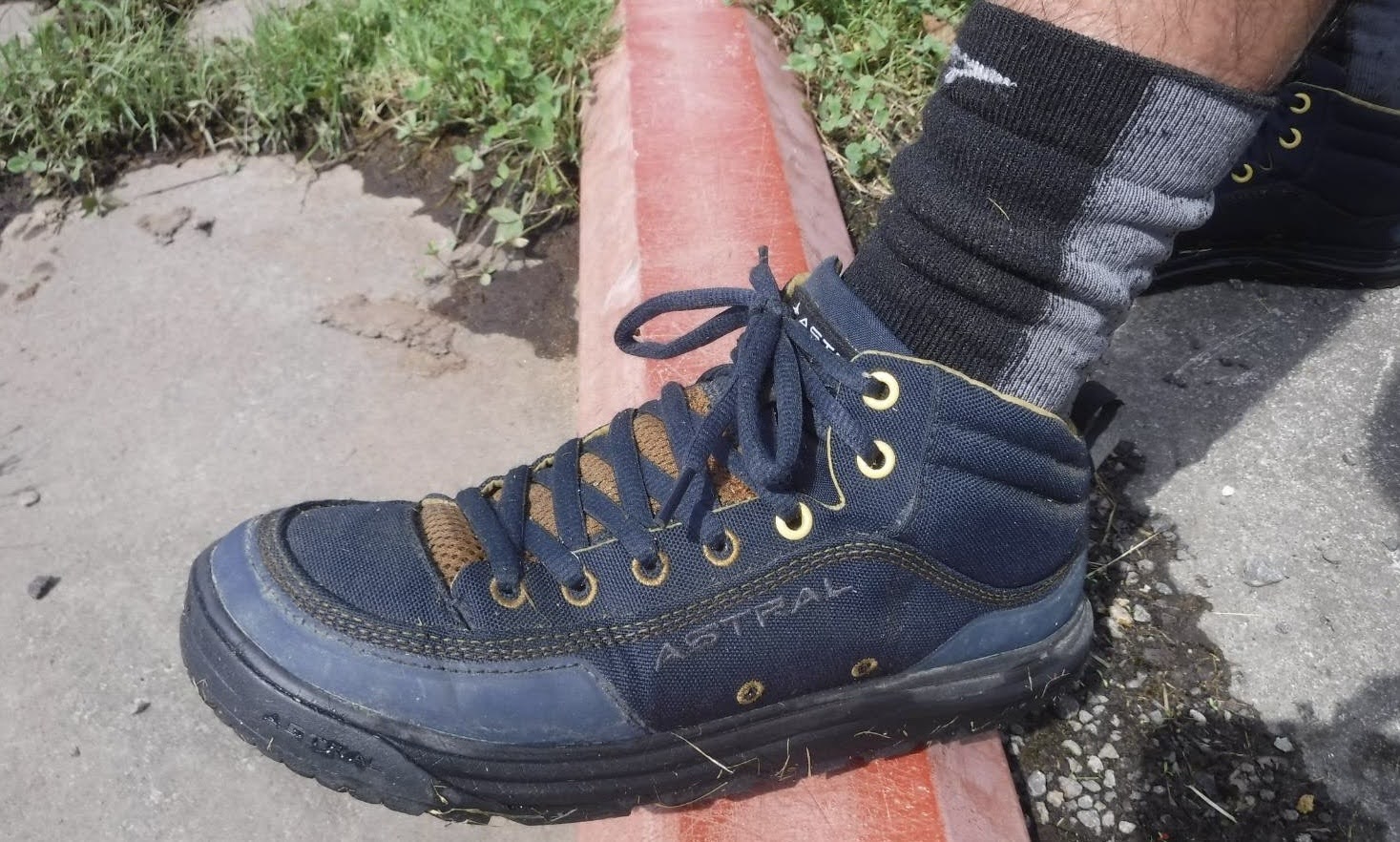
My warm-weather setup: dry top or spray jacket on top, NRS Hydroskin 0.5mm neoprene shorts with surf shorts layered over them on the bottom. For footwear, as I wrote in a previous post, I paddle in the Astral Rassler 2.0 water shoes. So the question I kept coming back to: what do I wear for socks?
Neoprene Socks, or Something Else?
The search for an optimal packrafting sock. Neoprene socks are warm and comfortable on the water — but they’re not practical for hiking in, which means carrying a second pair and changing over. More gear, more hassle.
Could Drymax Be the Answer?
Drymax has a strong reputation in the trail running world. Everyone I’ve spoken to who runs trails has something positive to say about them. A friend who had persistent foot problems from moisture in everyday life told me his issues disappeared entirely after switching to Drymax socks for daily use. The word of mouth has been consistently good.
Thinking through the foot conditions in a typical packraft trip:
- Traveling to the put-in → basically dry
- Hiking in with the packraft → like any mountain approach, alternating dry and wet depending on terrain
- On the water paddling → primarily wet
- Back on land, hiking out after paddling → wet, and wanting to get dry as fast as possible
What Drymax Claims
Drymax uses a proprietary fiber technology that they state keeps feet approximately 25 times drier than conventional materials like polyester, acrylic, nylon, or wool — based on their own testing. The core pitch: moisture is the primary cause of blisters and foot problems, and staying dry dramatically reduces those issues.
That framing resonated immediately for packrafting. If the sock can actively push moisture away from the foot rather than holding it, the hike-to-paddle-to-hike cycle gets a lot more manageable.
I ordered a pair and put them to the test on a packraft trip that involved repeated alternation between hiking and paddling with multiple portages.
The Model I Tested: Drymax Cold Weather Running Crew
The Cold Weather Running Crew is described as a model optimized for low-temperature conditions. In addition to the standard moisture-wicking construction, it adds Drymax fiber insulation across the forefoot to reduce heat loss — particularly from windchill. The logic being that in cold weather, moisture pulls heat from skin 23 times faster than air alone, making dryness a safety issue as well as a comfort one.
Field Results
The honest assessment: when hiking, the socks do progressively dry out — there’s a real sensation of moisture moving away from the foot as you walk. That part works.
The limitation I ran into: this model is designed for cold-weather running, which means it’s built thicker for insulation. Thicker fabric holds more water when saturated — that’s straightforward physics. In a scenario with repeated, short portage sections where the sock gets wet, starts to dry, then gets wet again without enough dry time in between, the drying cycle never fully completes. On that kind of trip, I noticed the early signs of foot discomfort starting to develop.
The conclusion: for trips with longer hiking sections between paddles, this sock works well. For high-portage trips with short intervals between water crossings, a thinner Drymax model would likely perform better. That’s what I’m planning to test next season.
The concept is right — the specific model just needs to match the trip type.
コメント