
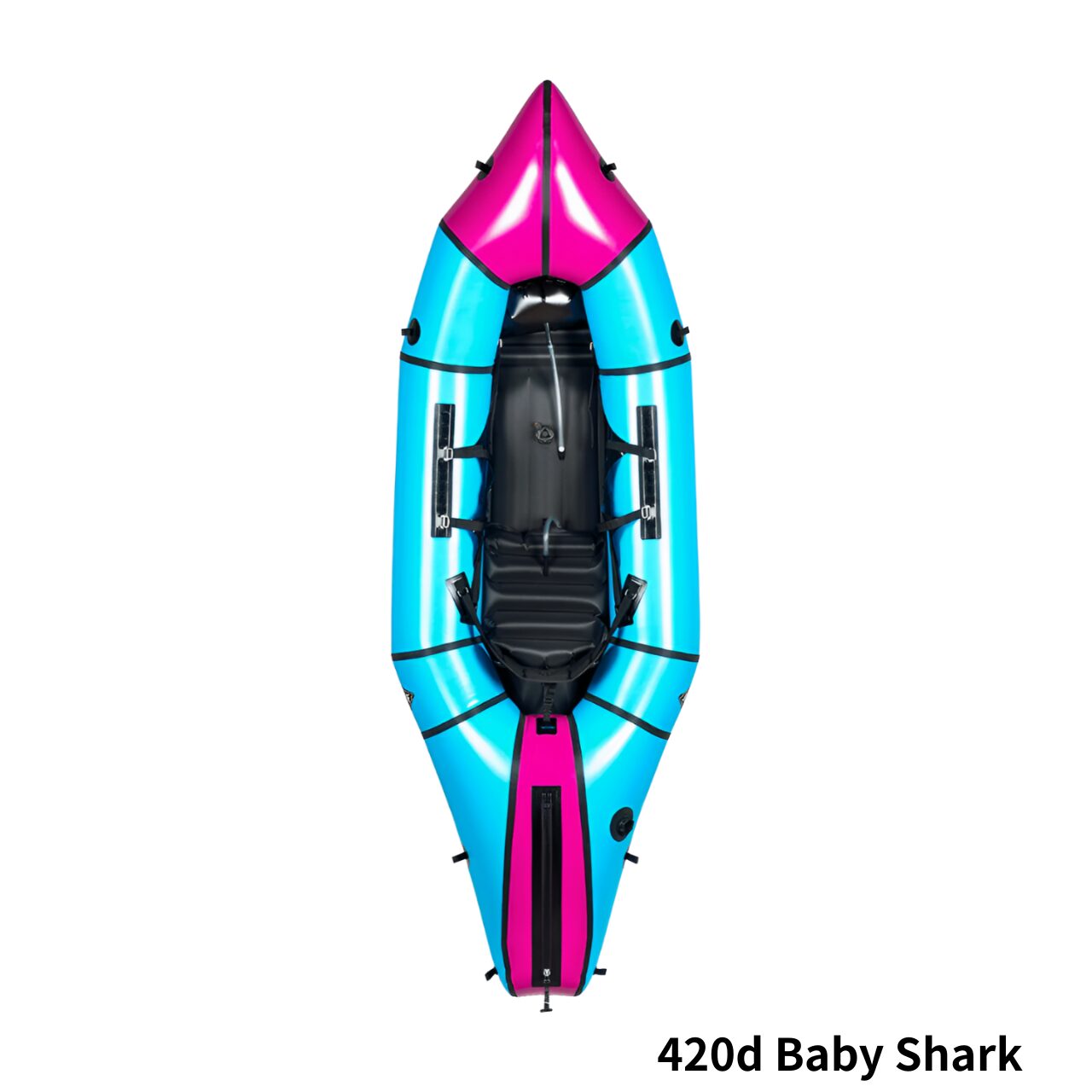
The Mage is not a versatile all-rounder. But in the right environment, it has a clear advantage over other packrafts. Its core strengths — light weight, responsiveness, and line precision — are most valuable on rivers where you paddle deliberately, not rivers where you drift passively.
Here’s how it rates across field types.
Technical Small-to-Mid Rivers — ◎ Ideal
This is where the Mage performs best.
Shallow, rocky rivers with small eddies, narrow lines, and frequent sequential decisions demand handling precision over raw stability. The Mage grips the water with its narrower tube, fits into tight eddies, and transitions quickly between moves.
On rivers that would be a strength contest in a heavier boat, the Mage turns it into a technique contest — which is both safer and more satisfying for paddlers who have the skills.
Headwaters and Mountain Streams — ◎ Excellent Match
The Mage is designed exactly for the hike-in, paddle-down style of adventure that headwater terrain demands.
Light enough for long approaches; maneuverable enough to thread through low-water obstacles and boulder gardens; fast enough to respond to drops and read narrow channels. In sections where hiking and paddling alternate, the weight difference over a session adds up significantly. The Mage is purpose-built for this mode of travel.
Creeks — ○ Capable, for Technical Paddlers
The Mage has the technical capability for steep creek descents. But it does not offer stability as a safety margin.
It suits creek paddling when: lines are scouted and understood; the paddler can execute ferries and eddy catches reliably; the descent is actively controlled rather than passively managed.
It’s not the right choice for: passive descents where stability absorbs mistakes; high consequence lines without the technical skill to match.
Long Downrivers — ○ Possible, Not Optimal
The Mage can run longer rivers, but it’s not ideally suited to touring-focused downrivers with significant load or sustained flatwater.
Buoyancy reserves are limited; loaded trim affects handling; it’s more susceptible to being pushed around in big open water. Boats optimized for tracking and efficiency will be more comfortable over sustained distance. The Mage is in “can do it, but won’t love it” territory here.
Big Water — △ Paddler-Dependent
High-volume water with large wave trains favors boats with more buoyancy and stability — the Gnarwhal fits better here. The Mage is a line-selection boat, not a wave-survival boat.
That said, experienced paddlers with strong read-and-run skills can use the Mage in bigger water effectively. It’s a skill-dependent scenario more than an absolute limit.
Field Suitability Summary
| Field type | Suitability |
|---|---|
| Technical small-to-mid rivers | ◎ Best match |
| Headwaters / mountain streams | ◎ Excellent |
| Creeks | ○ Technical paddlers |
| Long touring downrivers | ○ Possible, not optimal |
| Big water | △ Paddler-dependent |
The Core Principle
The Mage is not a boat that carries you down a river. It’s a boat for paddlers who choose their line and make it happen.
It’s not about river size — it’s about how much active paddling the river demands. The more decision-making and technical input required, the better the Mage performs.
Product Links
Mage 210d Self-Bailer with Cargo Fly [2026] → Web Shop Mage 420d Self-Bailer with Cargo Fly [2026] → Web Shop Mage 210d WW Deck with Cargo Fly [2026] → Web Shop Mage 420d WW Deck with Cargo Fly [2026] → Web Shop


コメント