Compared to other Alpacka models, the Scout has three clear priorities: weight first, simple structure, daily portability. The result is a boat whose primary purpose is making it easy to bring one along — and letting the adventure figure itself out from there.
1. Weight — Approximately 1.6 kg
The Scout’s defining advantage is its weight. At around 1.6 kg for the full kit (boat and basic gear), it fits inside a backpack without adding meaningful load. Long approaches on foot don’t become harder because of it. The practical results: you can carry it to a remote lake or mountain stream; it pairs naturally with ultralight backpacking; it fits in dead space on a bike or moto trip; and it’s easy enough to bring that leaving it behind stops being the default decision.
2. Compact — Fits Anywhere
At 218 cm long and 86 cm wide, the Scout remains manageable in ways larger boats aren’t. It’s the packraft that makes “stop here for a quick paddle” a realistic mid-trip option — something canoes and rigid boats simply can’t offer.
3. Simple Structure — No Setup Friction
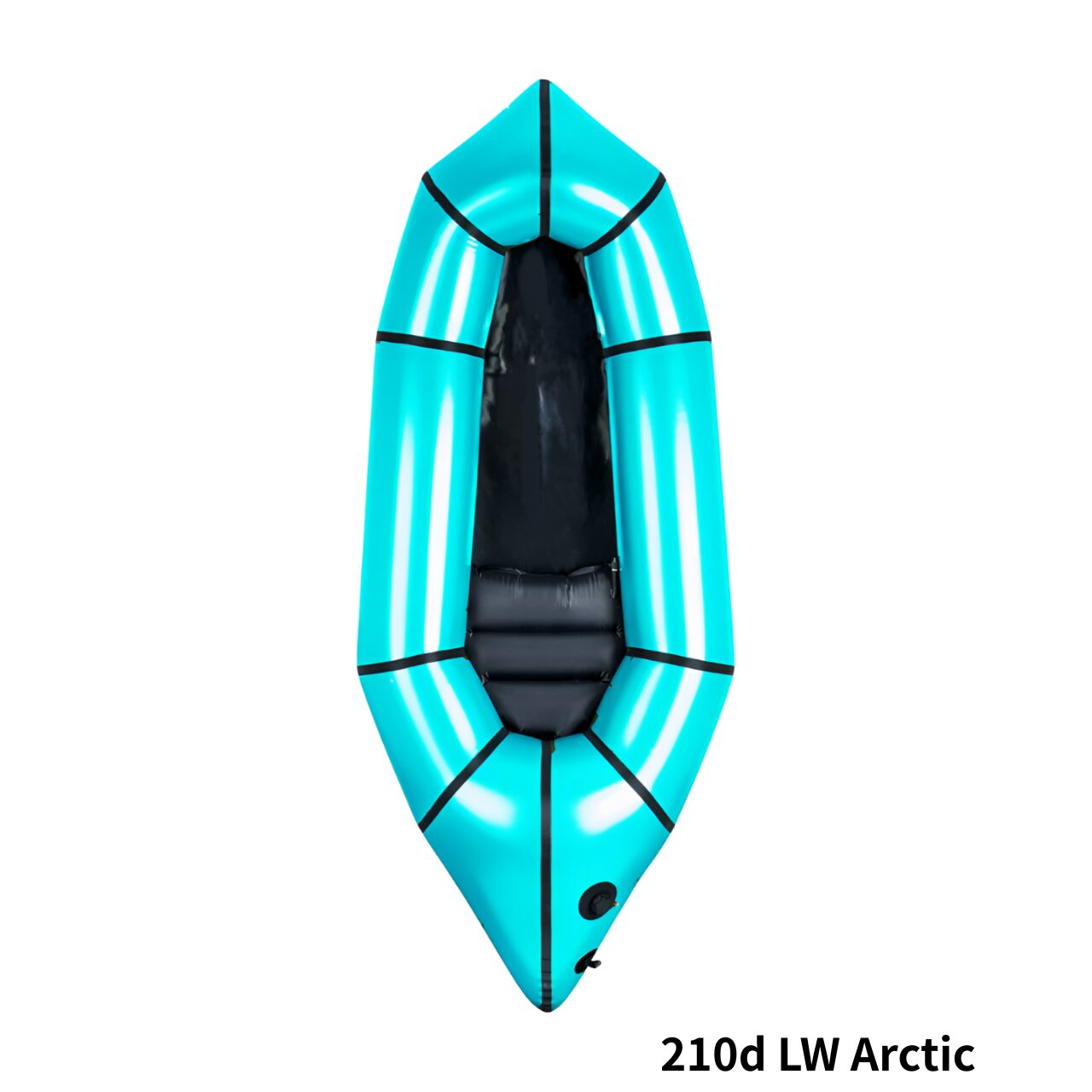
The Scout is open-deck only, with no whitewater deck and no cargo fly (though cargo fly is available as a custom option). What’s included: a Scout-specific seat, one stern grab loop, floor seat toggle, inflation bag, stuff sack, and a basic repair kit. You inflate it, get in, and paddle. That’s the whole process.
4. Handling — Intuitive on Calm Water
The Scout has the inherent stability of a packraft on flatwater. It doesn’t demand the kind of active corrections that technical models require. Lake cruising, casual river stretches, and impromptu paddling near a campsite are all well within its comfort range. Note: like most open-deck packrafts, it’s sensitive to strong wind — use caution in exposed conditions.
5. Load Balance — Light Travel Companion
The Scout works best with body weight only, or a small pack for a day kit. Loading beyond that changes the trim and dulls the feel. It’s designed around paddler plus minimal gear, not paddler plus expedition supplies. Keeping the load light is part of keeping the Scout working as designed.
6. Flatwater Versatility
The Scout’s best environments: lakes, ponds, calm river sections. The ideal Scout session is: a clear morning, a quick inflate, a lake crossing, back to camp. Or: a rest day with a short river wander. Or: bikepacking with an alpine lake at the midpoint. It’s not a boat that makes paddling the centerpiece — it’s a boat that adds water to trips that weren’t originally about water.
7. Materials and Durability
Hull: 210d LW nylon with TPU coating. Floor: 420d nylon. This construction achieves the target weight while maintaining structural integrity for calm and moderate water use. It’s not rated for rock-heavy river environments — the 840d floor on the Caribou and Expedition is a meaningful difference for that kind of use.
8. The Value of “I Can Bring It”
The Scout’s most important quality isn’t measurable in specs. It’s the psychological ease of deciding to bring it. Strapping it to a bike rack. Throwing it in a pack when you’re not sure if there’s water on the route. That decision becomes frictionless in a way that heavier, more complex boats never allow. This is what the Scout uniquely provides.
Summary
Packability: 1.6 kg — doesn’t burden the trip. Simplicity: No complex setup; inflate and paddle. Stability: Sufficient for calm water and lake use. Versatility: Perfect travel supplement.
Product Link
Scout 210d LW Open Deck [2026] → Web Shop

コメント