
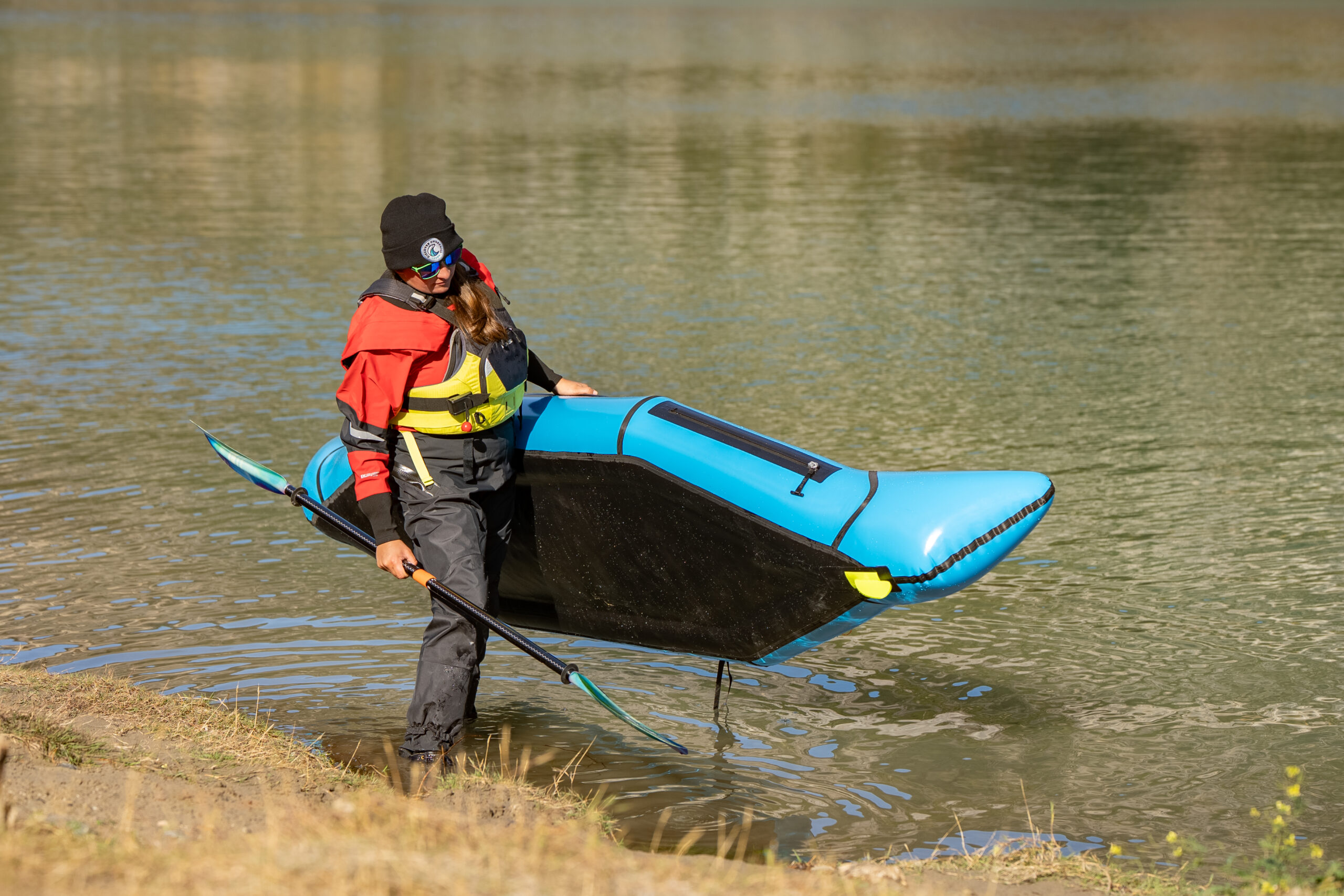
The Chinook’s expedition capability doesn’t come only from its hull length or removable skeg.
The cargo fly is the other half of the equation.
What appears to be a storage zipper is actually the central system that defines this boat’s multi-day performance.
What the Cargo Fly Is
The cargo fly is a TIZIP airtight zipper on the stern of the Chinook that provides direct access to the interior of the hull tubes. Gear is stored inside the hull — not on top of the deck.
This single design decision changes how the boat performs in every meaningful way.
Four Effects of Internal Storage
1. Center of gravity drops. Gear placed low inside the hull brings the overall weight distribution downward. This is mechanically straightforward, but the paddling consequence is significant.
2. Stability increases. A lower center of gravity means less lateral roll response. A fully loaded Chinook with gear inside the hull behaves fundamentally differently from the same load stacked on deck. The difference is most felt during long-distance paddling, where sustained stability reduces fatigue.
3. Wind resistance decreases. Deck-mounted gear creates a profile that catches wind. Internal storage leaves the hull’s outline intact. On open lakes and large rivers where wind exposure is continuous, this reduction in wind-affected surface area has a direct impact on tracking and steering effort.
4. The cockpit stays open. Without gear at the feet or across the lap, paddling posture is unrestricted. Stroke mechanics are better, position changes are easier, and getting in and out of the boat is simpler. On multi-day trips where physical fatigue accumulates, cockpit comfort is an operational factor.
Compatibility with Alpacka Dry Bag Liners
Alpacka’s purpose-built cargo fly dry bags are designed specifically for this system. They clip to the hull interior via quick-release buckles, which prevents load from shifting and keeps weight distribution balanced throughout the trip.
The critical additional function: the zipper-style dry bag liner serves as a secondary flotation chamber.
If the packraft hull is punctured, the sealed dry bag inside the tube maintains buoyancy. It becomes an emergency flotation device — not just stored gear, but a safety buffer that provides time and margin to reach shore.
This is not a convenience feature. It is a safety system.
Available in small, standard, and XL sizes:
- Cargo Fly Roll-Top Inner Dry Bag — Small (2-pack)
- Cargo Fly Roll-Top Inner Dry Bag — Standard (2-pack)
- Cargo Fly Roll-Top Inner Dry Bag — XL (2-pack)
- Cargo Fly Zipper Inner Dry Bag — Standard (2-pack)
Why This Makes the Chinook an Expedition Model
A multi-day trip requires tent, sleeping bag, food, fuel, and full kit. Loading all of that onto the deck of a packraft changes the boat’s behavior in ways that compound over the day — higher center of gravity, more wind surface, restricted cockpit, increasing instability.
The cargo fly addresses each of these directly. This is why the Chinook is classified as an expedition model: not just because of its hull, but because its internal storage system allows full expedition loads to be carried without compromising the boat’s essential characteristics.
Why It Justifies the Price
The Chinook carries a higher price point. The cargo fly system is a primary reason.
It delivers three functions simultaneously: expedition-grade load management, active performance enhancement through weight optimization, and a secondary safety system through the dry bag liner.
This isn’t an accessory or an upgrade option. It is what makes the Chinook what it is.
Summary
The cargo fly is not a convenience feature. It raises performance, improves stability, and increases safety — all from a system that looks, at a glance, like a zipper on the stern.
Understanding the cargo fly is understanding the Chinook.
Product Links
Chinook 210d Flatwater Spray Deck [2026] — One Size → Web Shop

コメント