
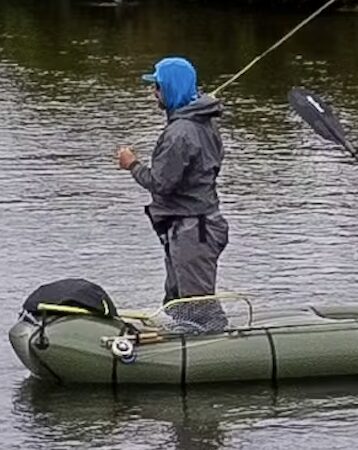
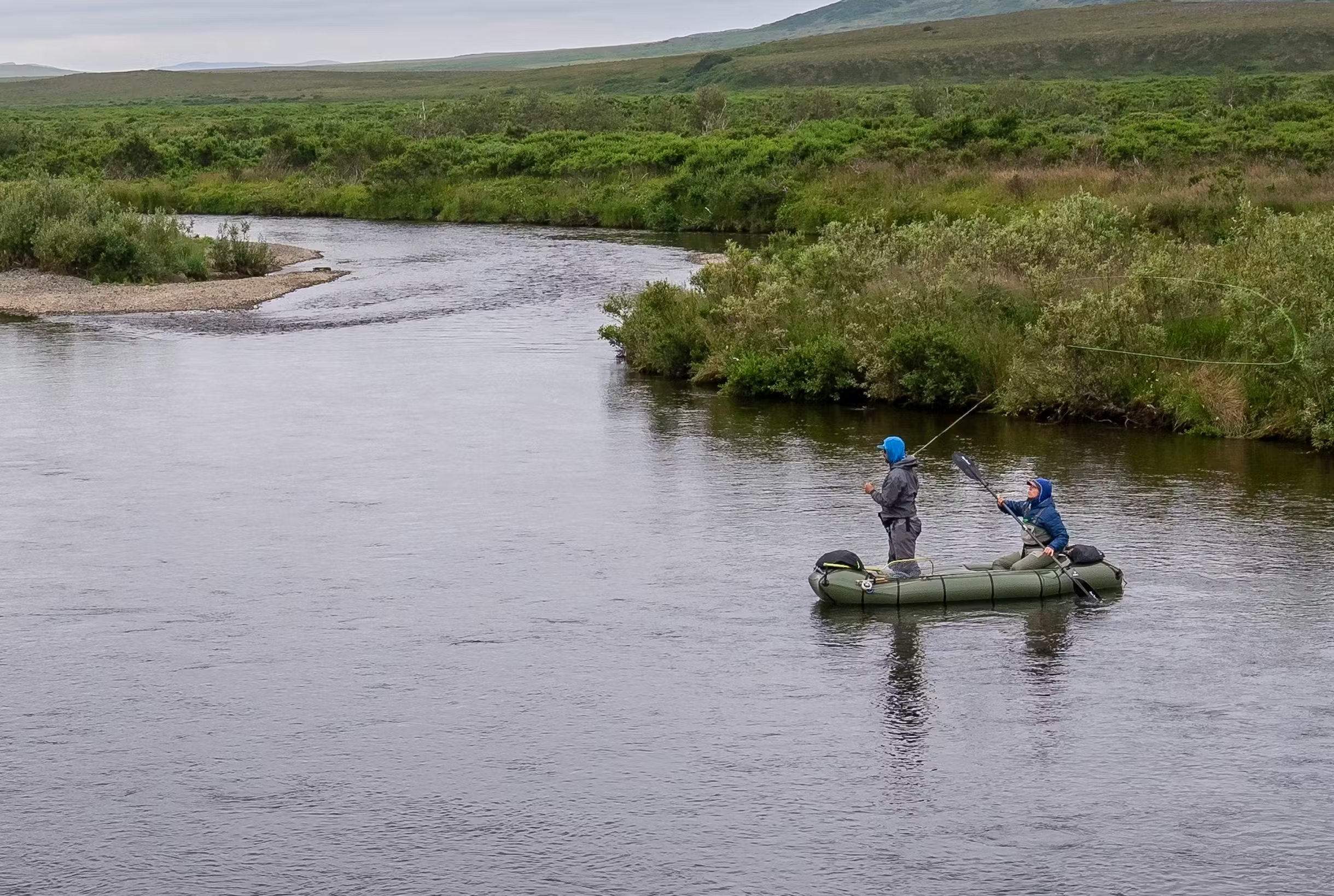
“I heard you can cast standing up from the Rendezvous. How does that work?”
The answer is the thwart — a hull-integrated crossbar that serves as the forward paddler’s seat and standing platform simultaneously. This article explains what a thwart is, what it makes possible, and how it differs from conventional packraft seating.
What Is a Thwart?
A thwart is the crossbar used in Canadian canoes — a structural member that spans the hull from side to side. In a traditional canoe, its primary function is to maintain lateral rigidity: it keeps the hull from splaying under load. Paddlers typically sit on or straddle the thwart, making it a seat as well as a structural component.
The Rendezvous takes this design principle and applies it to an inflatable packraft hull. A fixed thwart is built into the Rendezvous at midship, spanning the tube and functioning as both a structural reinforcement and a forward paddler’s seat — and standing platform.
This is a meaningful design departure from how other packrafts handle multi-person seating.
Three Things the Rendezvous Thwart Makes Possible
1. Standing capability
The most important fishing application: the forward paddler can stand on the thwart and cast from a full standing position. The rear paddler can stand as well.
Why this works: The thwart is fixed to both sides of the hull, distributing the weight of a standing person across the entire tube structure. Without a thwart, a packraft floor has no rigid anchor point for a standing paddler — balance becomes precarious and the hull deforms under uneven load. The thwart solves both problems.
2. Hull rigidity under two-person load
An inflatable hull naturally flexes under weight. With two adults, the flex increases and the hull can lose shape — reducing paddling efficiency and affecting tracking.
The thwart reinforces the hull laterally, reducing flex under load. Two people paddling the Rendezvous get a stiffer, more efficient hull than the unmodified tube alone would provide.
3. No separate passenger seat required
Conventional multi-person packraft setups require carrying, installing, and managing a removable passenger seat. The Rendezvous thwart eliminates this entirely. Inflate the boat and both paddler positions are ready — the thwart is always there, built in.
Standing Cast Fishing — What It Actually Changes
For fly fishing in particular, the difference between seated and standing casting is significant.
Seated casting limitations:
- Lower sightline — harder to read water and spot fish
- More restricted backcast — less clearance above the water
- More constrained casting form — distance and accuracy both suffer
- Obstacles (vegetation, banks, rocks) are harder to cast over from seat height
Standing cast from the Rendezvous thwart:
- Elevated sightline — better water reading and fish spotting
- Full backcast clearance — natural casting arc above the water
- Natural casting form — full range of motion for distance and accuracy
- Easier casting over obstacles
The thwart doesn’t change the fundamentals of fly casting. It removes the constraints that seated casting imposes. A skilled angler on the Rendezvous can cast as effectively as they would from a drift boat or a wading position — which no other packraft currently allows.
Thwart vs Removable Seat — A Direct Comparison
| Rendezvous thwart | Removable passenger seat | |
|---|---|---|
| Standing capability | ◎ | × |
| Hull rigidity contribution | ◎ | × |
| Setup required | None (built in) | Required each use |
| Extra parts to carry | None | Yes |
| Packing complexity | ◎ | △ |
| Seat height | Elevated (thwart position) | Low (floor level) |
| Long-session comfort | ◎ | △ |
The thwart’s advantages over a removable seat come down to two things: it enables standing, and it requires nothing extra. Both follow from being part of the hull rather than an accessory attached to it.
Notes on Using the Thwart
Water conditions
The Rendezvous is an open deck boat. The thwart makes standing possible, but the standing platform is only appropriate on flatwater and gentle current. In significant waves or strong current, standing becomes unsafe regardless of the thwart. The Rendezvous belongs on flatwater to Class I conditions — keep it there.
Building balance on the thwart
First-time standing on the Rendezvous will feel unfamiliar. The boat moves under your feet in ways a solid-hulled drift boat doesn’t. Start on calm water, get comfortable with how the hull responds to your weight, and build confidence before standing in any moving water.
Coordination between paddlers
If the forward paddler is standing and casting, the rear paddler should communicate before making any sudden movements. An unexpected shift in the boat’s position while the forward angler is standing can cause a loss of balance. Verbal communication before repositioning is the standard practice — call it out before you move.
Summary
The Rendezvous thwart system brings Canadian canoe design into the packraft format — providing standing capability, hull rigidity, and simplified setup that no removable seat can match.
For fishing, the thwart is what makes the Rendezvous categorically different from other packrafts. It doesn’t just improve fishing — it enables a casting position that every other packraft in the lineup makes impossible.
Product Link
→ AlpackaRaft Rendezvous 210d Open Deck with Cargo Fly — Packraft Hokkaido Web Shop
Related Articles
- AlpackaRaft Rendezvous — Complete Guide
- Is the AlpackaRaft Rendezvous the Best Fishing Packraft?
- Rendezvous vs Forager — Choosing Between AlpackaRaft’s Two-Person Models

コメント