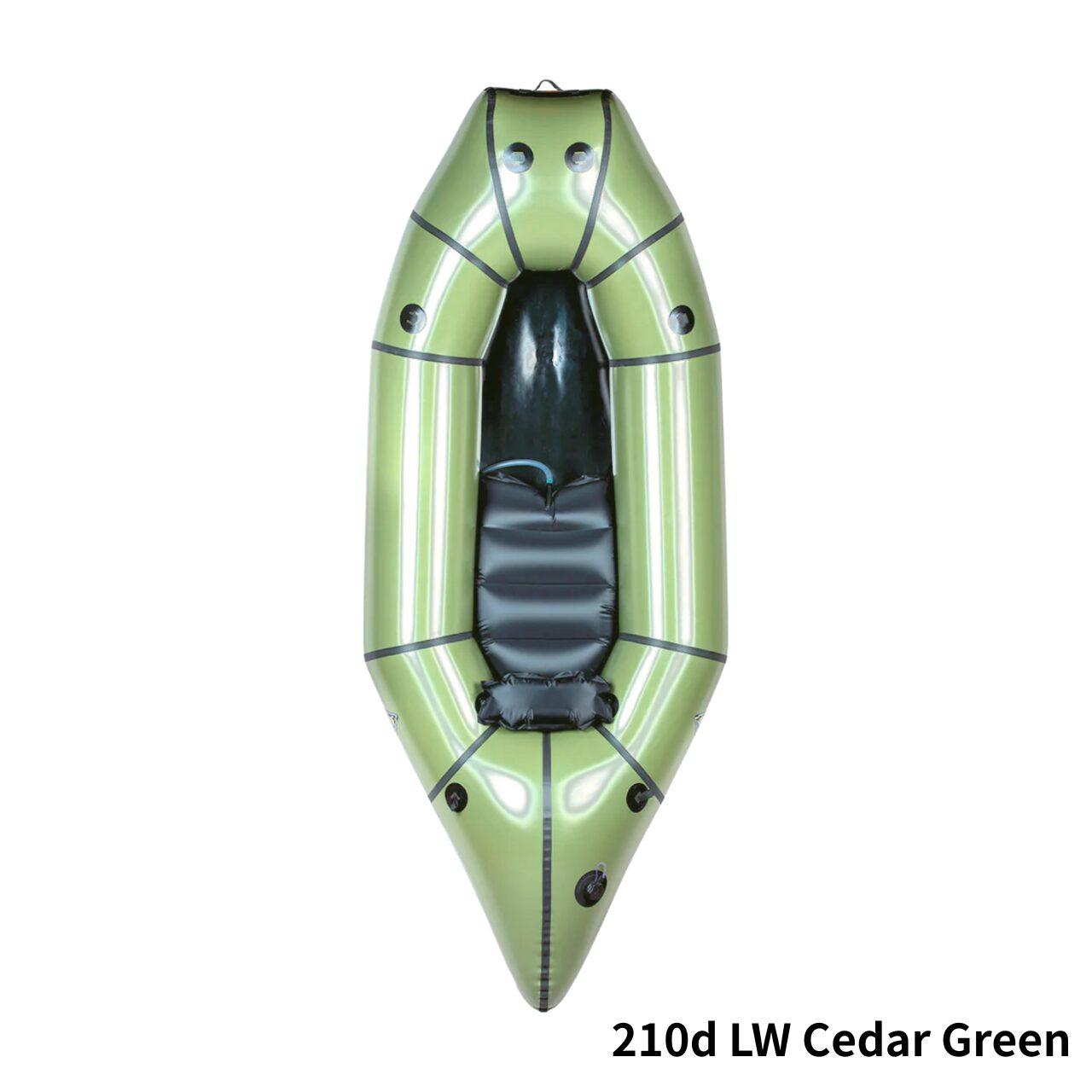
The AlpackaRaft lineup isn’t ranked by quality — each model is built around a different field and a different way of paddling. The question isn’t which one is best; it’s which one matches what you actually want to do. This guide consolidates the comparison articles that were previously scattered across the site into one reference, organized into five groups: whitewater, entry-level, load-carrying, cruising, and multi-person models.
- How to Use This Guide
- Whitewater Models: Expedition, Gnarwhal, and Mage
- Entry-Level Models: Caribou vs Expedition, and Scout vs Caribou
- Load-Carrying and Backcountry Models: Mule vs Caribou vs Ranger
- Multi-Person Models: Forager vs Rendezvous, and Forager vs Ranger
- Cruising and Flatwater Models: Chinook, Aleutian, and Zephyr
- Advanced Whitewater: Refuge vs Gnarwhal
- Quick Reference: All Models
- Related Links
How to Use This Guide
Each model also has its own standalone complete guide with full specs and packing examples. This page is built for the moment of deciding between two specific models — for deeper detail on any single model, follow the links into its complete guide.
Whitewater Models: Expedition, Gnarwhal, and Mage
These three boats are best understood as a division of roles, not a ranking. The Expedition is the all-round river travel boat, the Gnarwhal is the stable platform for building whitewater experience, and the Mage is the technical instrument for active control.
| Expedition | Gnarwhal | Mage | |
|---|---|---|---|
| Role | River travel, all-round | Stable WW, beginner–intermediate | Technical WW sport boat |
| Deck | WW deck | Self-bailer | Self-bailer / WW deck |
| Fits paddlers who | Want scenery and journeys | Want to build experience with confidence | Want to sharpen technique and control |
A common and costly assumption is that beginners should choose the Gnarwhal and intermediates should upgrade to the Mage. That framework is wrong. What matters is paddling mindset, not skill level — a beginner drawn to technical control may prefer the Mage, and an experienced paddler who values stability may prefer the Gnarwhal regardless of skill.
Gnarwhal vs Expedition. The core difference is structural: the Gnarwhal is a self-bailer (water enters and drains), the Expedition runs a closed WW deck (water stays out). That single difference shapes everything else — how easy re-entry is after a flip, how much cold resistance the boat offers, and how much gear it can carry. Because a self-bailer keeps you in continuous contact with the water, the Expedition has the edge in cold conditions and snowmelt season — relevant territory in Hokkaido. Summer-focused WW practice favors the Gnarwhal; a loaded river journey favors the Expedition.
Mage vs Gnarwhal. Both are whitewater-capable, but the Mage is the boat you steer and the Gnarwhal is the boat that holds you. The Gnarwhal’s wide tubes and buoyancy margin absorb mistakes — a passive safety model where the boat corrects itself. The Mage responds fast and holds precise lines — an active safety model where the paddler stays out of danger by choice rather than being bailed out by the hull. On narrow technical rivers the Mage has the edge; on big, wave-heavy water the Gnarwhal is less tiring. The most common progression is to start with the Expedition, then add a Gnarwhal for stability-focused paddling or a Mage for technique-focused paddling as a second boat.
Entry-Level Models: Caribou vs Expedition, and Scout vs Caribou
Is the Caribou a good first packraft? For lakes, calm rivers, and backpacking or bikepacking-style access, the Caribou is a fully valid first boat. Its light weight directly expands where you can realistically go, and the open-deck configuration is simple to get in and out of. The Expedition is the better starting point for paddlers who want to actively run rivers with rapids, paddle often in cold or rough conditions, or want one boat to cover everything. The Caribou isn’t a universal tool, but working through what it can do before moving up is a reasonable path in its own right.
Scout vs Caribou. These look like similar lightweight packrafts, but they’re built for different worlds. The Scout’s roughly 1.6kg comes from a deliberate design goal: lightness for carrying, achieved through a 420d floor, open-deck-only construction, and minimal attachments. The Caribou is built for strength on the water instead — an 840d floor, a choice of deck configuration, and meaningfully higher load capacity. The Scout is a travel supplement, a “plus-one” piece of gear; the Caribou is a dedicated paddling boat that the trip is built around. Choose the Scout for flatwater-focused travel accents, the Caribou if moving water is part of the plan.
Load-Carrying and Backcountry Models: Mule vs Caribou vs Ranger
All three prioritize load capacity, but each has a different loading philosophy. The Caribou is a lightweight, stripped-down expedition model optimized for minimal-kit trips. The Ranger is built around comfort on the water — a roughly 149.8cm cockpit and generous interior space designed with a dog or child riding along, making it “river luxury.” The Mule is built around the entire journey to the water, not just the water itself: it packs compactly for the approach and carries meaningful margin for gear plus game, which is what makes it the right tool for hunting and heavy-load backcountry trips.
If keeping weight down for a lightweight mountain expedition is the priority, choose the Caribou. If river comfort with a passenger is the priority, choose the Ranger. If the trip requires carrying real weight — gear, game, or both — choose the Mule.
→ Ranger product page: https://packhokkaido.base.shop/categories/7217179
Multi-Person Models: Forager vs Rendezvous, and Forager vs Ranger
Forager vs Rendezvous. Both boats carry two people, but “both carry two” doesn’t mean “both work the same way.” The Rendezvous is built around a hull-integrated central thwart that lets a paddler stand to cast — the only AlpackaRaft model that offers this — and it’s optimized for fishing and comfortable two-adult flatwater touring. The Forager is built around a self-bailing floor, which is what opens up Class III–IV whitewater, and its 420d nylon gives it the durability for hunting and large-game transport. If fishing is the primary purpose, the Rendezvous wins. If whitewater, hunting, or the whole family riding together is in the picture, the Forager is the only real option.
Forager vs Ranger. These share the same design at two different scales. The Forager is the maximum-capacity option, able to carry two adults or a mix of kids and pets, and it’s the only AlpackaRaft model that can transport a whole moose in a single load. The Ranger is the lighter, solo-optimized version, built for long hiking approaches where every gram carried on the back matters. Single-paddler weight limits are the same on both, but the Forager pulls ahead in multi-person capacity, cargo load, and maximum game weight. Choose the Ranger for long, steep solo approaches where weight is everything; choose the Forager when capacity — people, gear, or game — is the priority.
→ Rendezvous product page: https://packhokkaido.base.shop/items/120268561
→ Ranger product page: https://packhokkaido.base.shop/categories/7217179
Cruising and Flatwater Models: Chinook, Aleutian, and Zephyr
All three are built around covering distance efficiently on flatwater, but each is suited to a different kind of trip.
Chinook vs Aleutian. The Aleutian is the longest hull in the lineup, built with sea-kayak thinking for open-water and coastal expeditions. Its pure water performance can exceed the Chinook’s, but that comes at the cost of extra length and weight, which matters on portage sections. The Chinook is faster to portage and easier to handle in mixed terrain, which makes it the more practical choice for trips that combine water with overland movement — crossing lakes, linking rivers, carrying through forest. Choose the Aleutian for open-water speed, the Chinook for trips that include land.
Chinook vs Zephyr. This comparison has a key fact at its center: the two boats share the same hull, so their baseline cruising performance is essentially identical. The difference is entirely in the equipment package. The Chinook ships as a full expedition configuration — cargo fly internal storage, flatwater spray deck, three-point thigh straps — built for cold water and multi-day loaded travel. The Zephyr carries the same hull without the spray deck, making it lighter, simpler, and better suited to warm-season day use.
In a concrete case like lakeside camping, a one-night kit (roughly 8–12kg) sits comfortably within what the Zephyr handles, and the lighter weight translates directly into a more comfortable trip. The Chinook earns its keep when paddler weight is 80kg or more, the trip runs two nights or longer, the kit includes heavy items like camera gear, or the lake regularly sees strong wind. Afternoon wind is common on lakes, and on either boat, the right response to deteriorating conditions is to turn back — judgment matters more than which hull you’re in.
Multi-day, cold water, heavier gear → Chinook. Open water and coastal, speed-first → Aleutian. Day trips and casual use → Zephyr.
→ Chinook product page: https://packhokkaido.base.shop/items/130659877
→ Aleutian product page: https://packhokkaido.base.shop/items/130661570
Advanced Whitewater: Refuge vs Gnarwhal
Both are whitewater-capable, but the design intent runs in opposite directions. The Refuge is a lightweight agility model, built for carrying in on foot and reading the current with a nimble hull. The Gnarwhal is the stability-focused model, using its self-bailing structure to stay composed and recover well in big water. A common question — “isn’t the Refuge fine for Class IV?” — has a clear answer: for sustained Class IV, the Gnarwhal is the more appropriate choice. Choose the Refuge to extend your range on technical, carry-in rivers where lightness is the advantage; choose the Gnarwhal to take on serious whitewater with stability as the priority. The Refuge is available only as a Custom Lab order.
→ Refuge (Custom Lab) product page: https://packhokkaido.base.shop/items/122589649
Quick Reference: All Models
| What you want | Model |
|---|---|
| River travel, all-round | Expedition |
| Stable, forgiving whitewater | Gnarwhal |
| Technical, responsive whitewater | Mage |
| Advanced-level lightweight whitewater | Refuge |
| First boat for lakes and calm rivers | Caribou |
| As light as possible, a travel add-on | Scout |
| Heavy loads, hunting, backcountry expedition | Mule |
| River comfort with a passenger (dog/child) | Ranger |
| Multi-day, cold water, loaded lake travel | Chinook |
| Open water, coastal, speed-first | Aleutian |
| Day trips, casual flatwater | Zephyr |
| Large groups, whitewater, hunting | Forager |
| Fishing with a standing cast | Rendezvous |
Related Links
→ AlpackaRaft Expedition — Complete Guide
→ AlpackaRaft Gnarwhal — Complete Guide
→ AlpackaRaft Mage — Complete Guide
→ AlpackaRaft Caribou — Complete Guide
→ AlpackaRaft Mule — Complete Guide
→ AlpackaRaft Scout — Complete Guide
→ AlpackaRaft Zephyr — Complete Guide
→ AlpackaRaft Forager — Complete Guide
→ AlpackaRaft Refuge — Complete Guide
→ AlpackaRaft Rendezvous — Complete Guide
コメント