The Mule isn’t a speed model, and it isn’t a cruising expedition model built for distance. Its core value is margin — the headroom between what’s being carried and what the boat can handle without becoming difficult to control. For larger paddlers, heavy loads, dogs on board, and backcountry hunting, that margin matters more than being light or fast, and the Mule is built for exactly those situations.
What the Mule Is
A mule is an animal bred to carry loads — reliably, across terrain, without complaint. The name is direct and accurate: the Mule is designed around that same premise, a large-volume hull built from the start to carry rather than to sprint. It isn’t a wider version of another packraft — it’s a hull optimized for load as the primary design requirement.
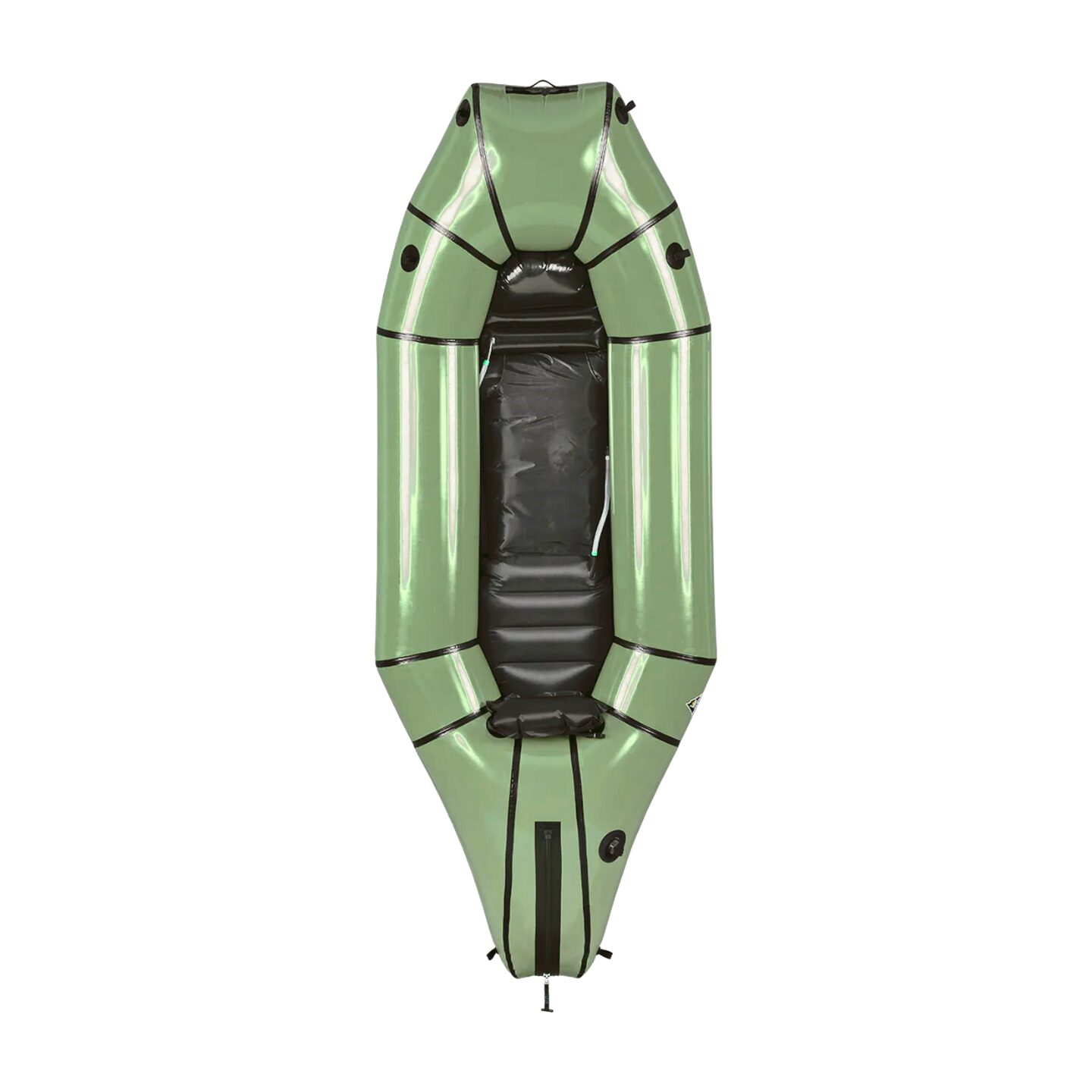
The center-back stern, high-volume hull provides buoyancy well above standard packrafts, resists hull sink under heavy loading, and holds inherent stability that doesn’t depend on paddler technique to maintain. It’s recommended for paddlers 173–203cm in height, with paddler weight capacity up to approximately 117kg, extending to roughly 136kg total with a dog or additional passenger aboard. Interior dimensions run 132cm long and 39cm wide, and the gradually tapering bow creates open foot space that fits large dry bags, coolers, hunting gear, and dog mats without the cramping typical of most packrafts.
It comes in two deck configurations, a lighter and simpler open deck or a self-bailer, and cargo fly internal storage can be added to either one. That covers everything from casual day paddling to serious backcountry missions on the same hull platform.
Who the Mule Is For
Larger paddlers who find standard packrafts cramped or riding low under their weight. Paddlers carrying heavy multi-day kit with no interest in cutting safety margins to save grams. Anyone bringing a dog on the water. Hunters and backcountry users who need the boat to carry gear or game back out as well as in. Paddlers who want clear headroom in load capacity rather than operating near a boat’s limits on every trip.
It isn’t the right choice for weight-first or speed-first priorities — it’s the right choice for paddlers who value confidence and margin over minimalism. The question worth asking isn’t whether it feels a bit big; it’s how much margin is actually needed. The Mule is the answer when that honest answer is more than most packrafts offer.
Load Capacity as the Real Point
Load capacity doesn’t just mean carrying a lot — it means performance doesn’t degrade once loaded. Overload a standard packraft and the hull sinks, stability drops, turning performance suffers, and wind starts pushing it around. In a word, it gets scary. The threshold before that fear sets in is meaningfully higher on the Mule.
The high-buoyancy hull resists sinking under load and holds a stable trim through weight shifts. Being able to carry gear without a fight also means less fatigue over a long day — a cockpit that isn’t cramped translates directly into how tired someone feels by the end of it.
That same volume benefits larger paddlers too: sudden weight shifts get absorbed by the hull rather than throwing off balance, and that resistance to feeling like it’s about to tip comes from the design itself, not just paddling technique.
Adding a cargo fly brings internal storage up to roughly 45kg, and stowing heavy gear inside the hull lowers the center of gravity and improves stability further. Total load capacity can exceed 90kg under the right conditions, with a stated maximum of 272kg under favorable conditions. The point isn’t just carrying more — it’s paddling comfortably while doing it.
Hunting and Backcountry Use
Packraft use in hunting contexts is uncommon in Japan, but the load ceiling that makes the Mule useful there applies just as directly to serious backcountry use in general.
The manufacturer’s intended scenario includes a hunter plus roughly 45kg of personal equipment plus roughly 68kg of harvested game. What matters isn’t the number itself — it’s that the boat holds stability under a load that would compromise most other packrafts. Game and gear are rarely distributed evenly, and a hull that tolerates that kind of imbalance is one that’s actually usable for the mission at hand.
A hardshell kayak can’t be carried into backcountry access points at all — portaging isn’t practical, and access is limited to water-adjacent terrain. The Mule in 210d open deck configuration weighs roughly 3.2kg: light enough to carry through forest, use to move gear or game via water, and carry back out again. That ability to link land and water in one piece of kit is the Mule’s core operational advantage in the backcountry, and it’s something no rigid boat can offer.
Paddling With a Dog
Dogs like water, and they take to packrafts more readily than most people expect — but not every packraft is actually safe for it. Forward space, buoyancy, stability, and load capacity all need to be in place at once, and the Mule is one of the few packrafts that covers all four.
The gradually tapering bow creates open foot space that lets a medium-sized dog lie flat without crowding the paddler, and a larger dog can extend its front legs. Dogs move without warning — standing up at a bird, leaning toward the water, turning around — and the Mule’s high-buoyancy hull resists the instability those sudden weight shifts would cause in a smaller boat.
Paddling with a dog also means more gear: a dog PFD, leash, towel, water, food. Because the Mule has load headroom to spare, none of that safety equipment has to be left behind to make room. Open deck is the more practical configuration for dogs specifically — easy in and out, easier retrieval if the dog goes overboard, and water drains more readily. A dog PFD is non-negotiable regardless of swimming ability, first sessions should happen on calm water, and a mat or cockpit pad is worth considering to protect the hull from claw contact. 210d handles most cases fine, but for dogs aboard frequently, 420d offers more comfortable durability margin.
Fabric Choice: 210d vs 420d
Denier measures thread thickness — higher numbers mean heavier, denser fabric.
| 210d | 420d | |
|---|---|---|
| Weight | Lighter | Heavier (approx. +270g) |
| Feel | Flexible, soft | Stiffer, denser |
| Abrasion resistance | Standard | High |
| Packability | Compresses easily | Slightly bulkier rolled |
210d is the right call for hiking-heavy trips, repeated portaging, and traverse-style multiday travel — anywhere the boat spends a lot of time on someone’s back, the weight advantage compounds. It’s also plenty for lakes and flatwater rivers where hull contact is minimal.
420d earns its weight penalty where contact with rock, gravel, and rough entry points is a regular event rather than an occasional one — rocky rivers, hunting and heavy backcountry use, or dogs aboard frequently. The roughly 270g difference is small, but the mental margin it buys is real: not worrying about a rock strike, a dog’s claws, or a heavier-than-usual load pushes the boat’s limits.
By use case: long carries on foot favor 210d; rocky or rough environments and hunting favor 420d; frequent dog paddling generally favors 420d, though a small dog on calm water with a protective mat can work fine on 210d; flatwater and lake-focused use is well served by 210d. When future use is genuinely uncertain, many paddlers choose 420d as a form of future-proofing.
Final Verdict and Lineup
The Mule isn’t a flashy model. But under conditions that are heavy, voluminous, or rough, its value becomes clear — a boat that manages to combine load capacity, stability, durability, and portability where most designs have to trade one against the others.
The lineup is chosen by combining fabric (210d / 420d), deck configuration (open deck / self-bailer), and cargo fly (none / zippered).
Related Links
→ Mule 210d Open Deck — No Cargo Fly https://packhokkaido.base.shop/items/119870502
→ Mule 420d Open Deck — No Cargo Fly https://packhokkaido.base.shop/items/119870079
→ Mule 210d Open Deck — With Cargo Fly Zipper https://packhokkaido.base.shop/items/119869670
→ Mule 420d Open Deck — With Cargo Fly Zipper https://packhokkaido.base.shop/items/119871046
→ Mule 210d Self-Bailer — With Cargo Fly Zipper https://packhokkaido.base.shop/items/119873168
→ Mule 420d Self-Bailer — With Cargo Fly Zipper https://packhokkaido.base.shop/items/119873324
コメント