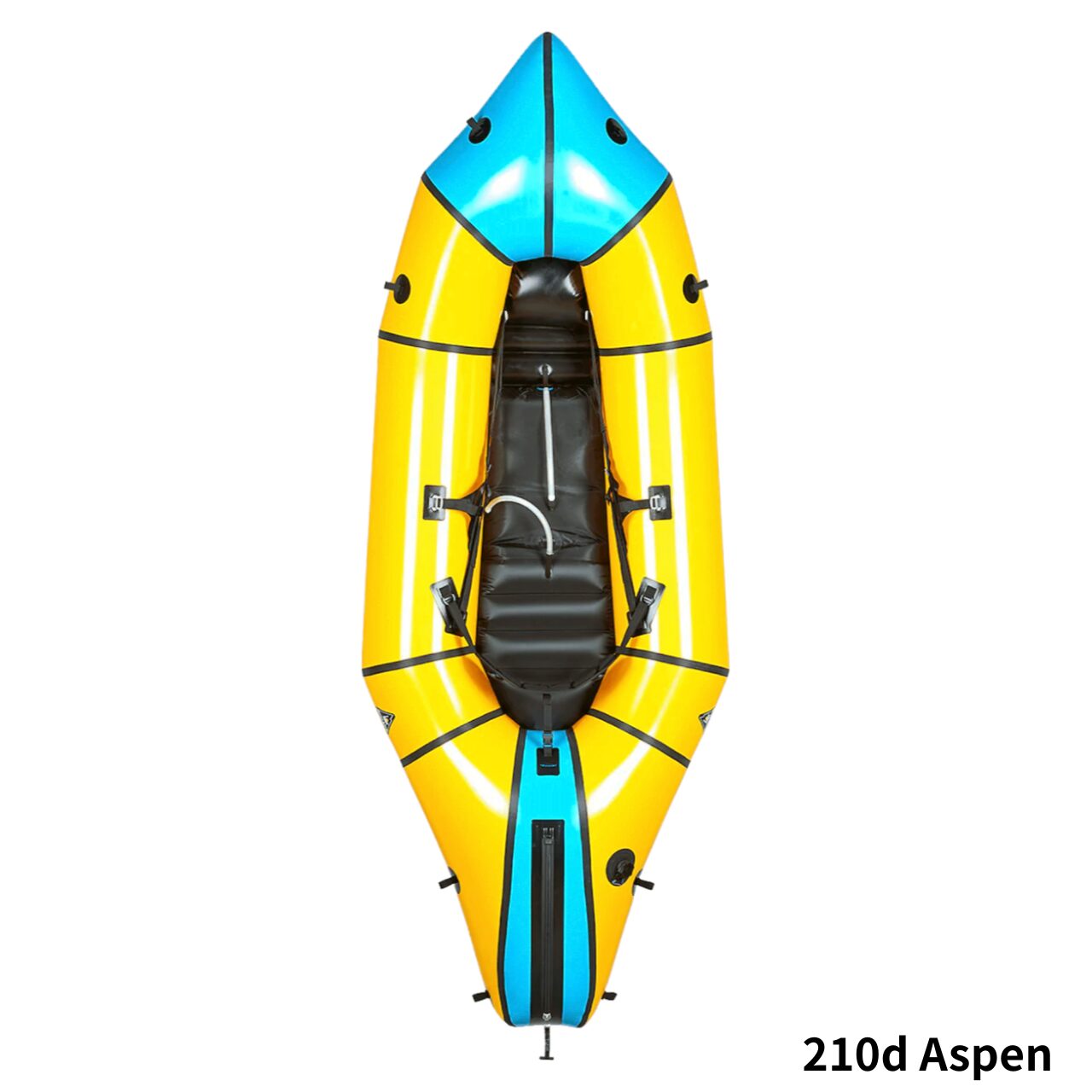
The Gnarwhal is a whitewater model positioned for lightwater through Class III, aimed at beginner-to-intermediate paddlers, built around a self-bailing hull with a stability-first design. It’s not billed as a hardcore whitewater specialist — its role is an approachable entry point into whitewater.
What the Gnarwhal Is
Since its 2017 debut, it’s been built around stability, forgiveness, and ease of paddling. As more advanced paddlers move on to boats like the Mage, the Gnarwhal’s position as the beginner-to-intermediate whitewater entry model has become clearer.
The 2025 model moved to a true-fit design, growing roughly 5cm longer for improved stability, and added a 3-point thigh strap system that handles Class III/IV while keeping weight and comfort in check. Hull design is now optimized separately by size range too — S/M builds on the Wolverine platform for handling, while L/XL uses a larger, more stable hull.
It also carries a Cargo Fly. The TIZIP airtight zipper allows storage inside the tube itself, lowering the center of gravity, improving paddling stability, and keeping gear dry — genuinely useful cargo capacity even on a whitewater-focused boat.
Who It’s Right For, and Who Should Look Elsewhere
Who it suits
- Paddlers wanting to get started in whitewater, working up toward Class III
- Paddlers who value stability and an easy-to-re-enter boat
- Anyone who wants to enjoy running rivers while also building skill, without wanting things too easy or too risky
Who should look elsewhere
- Year-round use centered on winter or cold climates (a decked boat suits this better)
- Paddlers after a dedicated advanced whitewater boat, or one built around rolling
- Anyone who doesn’t want to get wet, prefers calm water, or is paddling mainly for scenery (a decked boat is more comfortable)
Why It Suits Beginners
“Is it really okay to buy a whitewater-specific boat right out of the gate?” — that’s where a lot of people hesitate. The short answer: the Gnarwhal is genuinely built for a first encounter with whitewater. Not because it’s fast, but because it holds up even when things go wrong.
What actually scares beginners about moving water isn’t the water itself — it’s losing control, not knowing what to do after a flip, and not being able to restart. That difficulty of resetting is the real source of fear.
The Gnarwhal’s self-bailing hull means no need to drain water after a capsize, no need to get to shore, and a quick re-entry back into paddling. That’s not just a convenience — it means experience doesn’t get interrupted. On a decked boat, every mistake triggers the same sequence: flip, get to shore, drain, reattach the skirt, restart. Repeated enough times, that sequence builds up into fear, and paddlers stop trying things. Because the self-bailer keeps the cost of failure low, trying a line, practicing a ferry, or attempting an eddy catch all become natural repetitions — which is why paddlers on this boat tend to improve quickly.
The Gnarwhal’s stability isn’t tracking stability — it’s stability that recovers after being upset. It leans with a wave and comes back, and the process of that recovery is itself how paddlers learn to read the boat’s behavior. It’s not that the boat feels safe; it’s that its behavior is legible. That’s what makes it a good whitewater entry point.
Why It Works for River Trips Too
Whether the Gnarwhal is a pure whitewater boat is a common question, but it isn’t a whitewater-only boat — it’s built to let river travel and skill development happen at the same time.
The Gnarwhal’s defining trait isn’t speed or light weight — it’s forgiveness. It recovers when a wave throws it off balance, resists being swept off when a ferry fails, gets back to paddling quickly after a re-entry, and lets a paddler keep learning while descending. In short, it’s a boat that doesn’t stop. That matters over the course of a longer river trip.
What actually drains energy on a river trip isn’t distance — it’s the accumulation of landings, draining water, recovering position, and dealing with mistakes. Because the self-bailing Gnarwhal keeps moving through failure, it conserves energy over the long run, which is where its advantage on longer trips comes from. A decked boat stays dry, warm, and tracks well, but a mistake means stopping to reset. The Gnarwhal takes the opposite tradeoff: it gets wet, but it doesn’t stop. On a river trip, forward progress often matters more than staying comfortable.
Load capacity holds up too — roughly 9 to 13kg when optimized for whitewater performance, up to around 33kg for a standard river trip, and up to around 54kg for a long trip on a big river.
Choosing a Size
Sizing a whitewater packraft follows different logic than a touring boat. Because the Gnarwhal is designed to be stable, a size too large will still feel rideable — but handling drops noticeably. Sizing for comfort is a reliable way to end up disappointed with this boat.
The Gnarwhal is designed around a true fit. Bending the knees, tightening the thigh straps, and becoming one unit with the boat is what makes the performance show up — a kayak-leaning approach to fit. Sizing it the way you’d size a touring boat tends to land one size too big.
Height guidelines: up to 170cm → S; 168–180cm → M; 175–188cm → L; 186–198cm → XL (designed for a true fit). Weight guidelines run roughly up to 90kg for S/M and up to 113kg for L/XL, but leg length and hip flexibility matter more than weight. Paddlers with long legs can go a size up; a longer torso relative to legs is better served by sizing down.
Sizing down improves edging, speeds up learning to roll, resists being knocked around by waves, and keeps handling light — in whitewater, that added precision translates directly into safety. Sizing up improves initial stability, comfort over long sessions, and cargo room, at the direct cost of responsiveness.
The most common regret is sizing up to Large for extra room. With legs extended, the body isn’t held in place, waves throw the paddler around more, and progress slows. On the Gnarwhal, extra room doesn’t mean comfort — it means reduced control. Size down for skill development, size true for touring-leaning use, and size up if carrying more gear is the priority.
Is the Self-Bailer Cold?
Outside of summer, without a drysuit, it’s genuinely cold — in Hokkaido, the window for paddling this comfortably without one is short. That said, it isn’t unusably cold. Understanding where the cold actually comes from makes the comfortable range clear.
There are three sources of cold. Feet staying wet — water constantly flows in and drains out, so feet stay wet throughout, pulling heat away continuously. Evaporative cooling from wind — wind hitting wet skin cools rapidly, and this remains the dominant factor even with neoprene or a drysuit on. Rapid cooling during breaks — paddling keeps the body generating heat, but cooling accelerates sharply the moment movement stops, making long breaks the riskiest part of a session.
Rough comfort by water temperature (assuming a drysuit): 18°C+ is comfortable, 15°C is on the cool side, 12°C gets hard over long sessions, 10°C is clearly cold, and below 8°C makes breaks genuinely risky. By season in Japan, that translates to comfortable summers, a workable window in early summer and early autumn, and cold conditions in spring and snowmelt season.
Warmth strategy comes down to gear — thick neoprene socks and a drysuit with heavy base layers are the baseline — and behavior: avoid long breaks, skip windy days, and keep sessions short below 10°C. The self-bailer isn’t a cold boat so much as a wet boat — treat it as something that gets you wet by design and it’s genuinely comfortable, but fighting to stay dry in it is a losing battle. For practice and downriver paddling it’s an excellent choice; for long trips or year-round cold-climate use, a decked boat has the edge.
Specs and Final Verdict
Built with a 210d or 420d hull and an 840d floor. The 210d model (S size) has a base weight of roughly 2.49kg, putting it in the lighter class of whitewater models.
The Gnarwhal is a boat that widens the door into whitewater. Designed first for stability and ease of handling, it’s a well-rounded entry-level whitewater boat that stays useful for years.
Related Links
→ Gnarwhal 210d Self-Bailer [2026] https://packhokkaido.base.shop/items/120002574
→ Gnarwhal 420d Self-Bailer [2026] https://packhokkaido.base.shop/items/120002722
Comments