
“Can the Forager actually paddle well with a heavy load?”
This is one of the most common questions from people considering the Forager. The answer is yes — and the reason is in how the Cargo Fly system is designed.
It’s not simply that the Forager is big enough to hold more. It’s that where the load goes — and how — directly improves stability and handling. This article explains the Cargo Fly and XL loading system in practical terms.
What Is the Cargo Fly?
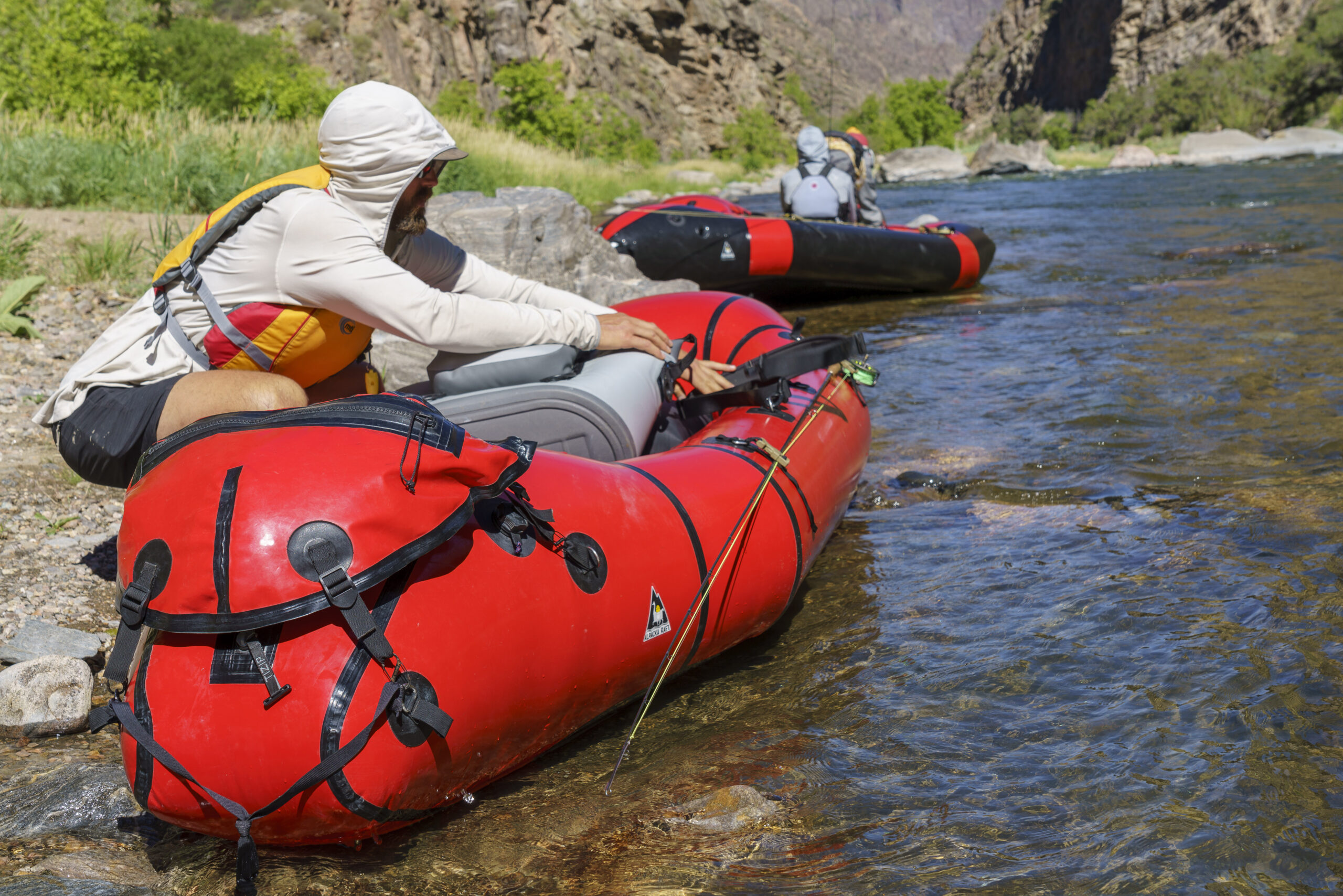
The Cargo Fly is a system that allows gear to be stored inside the packraft’s tube — the inflated hull itself — rather than on top of the boat.
A TIZIP airtight zipper at the stern opens the interior of the tube, giving direct access to a large storage chamber inside the hull.
Most packrafts store gear externally — on deck bungees, in a bow bag, or lashed to the outside. The Cargo Fly inverts this approach entirely. By putting weight inside the tube rather than on top of the boat, the center of gravity drops dramatically. The counterintuitive result: the more you load, the more stable the boat becomes.
XL Cargo Fly Capacity
The Forager’s version of the system is the XL Cargo Fly — larger than the standard Cargo Fly found on other AlpackaRaft models, and capable of holding several hundred pounds of gear.
| Use case | Capacity |
|---|---|
| Optimum performance | Approx. 90kg in Cargo Fly + 2 paddlers |
| Maximum (conditions/experience dependent) | Approx. 200kg |
| Hunting | Hunter + approx. 45kg personal gear + approx. 181kg animal |
| Flatwater theoretical maximum | Approx. 454kg |
All of this in a boat with a kit weight of approximately 6.3kg — light enough for two people to share the carry on approach.
Why Loading Increases Stability
This is counterintuitive but consistently observed in practice: a loaded Forager is more stable than an empty one.
The physics is straightforward. An inflatable packraft floats on air. When the tube is empty, the center of gravity sits relatively high. High center of gravity means more susceptibility to rolling and side-to-side instability in current and chop.
When gear goes inside the Cargo Fly, weight drops into the lowest part of the hull. The center of gravity lowers. The boat becomes more resistant to tipping and tracks better in a straight line.
The additional benefit: less external gear means less wind resistance and drag. A fully loaded Forager with everything inside the tube actually pushes through flatwater more efficiently than the same boat with gear piled on the deck.
Empty boat: Light to handle, but higher center of gravity, more affected by waves and current. Loaded boat: Center of gravity drops, stability increases, directional tracking improves.
The Inner Dry Bag — What It Does
AlpackaRaft recommends using the optional Inner Dry Bag (sold separately) in combination with the Cargo Fly. The Inner Dry Bag is designed specifically for this system — it clips to both sides of the tube interior via side-release buckles.
Three things the Inner Dry Bag adds
① Organization and weight distribution Loading gear directly into the Cargo Fly without the dry bag works, but organization is difficult. The Inner Dry Bag lets you pack systematically, and more importantly, distribute weight evenly between left and right sides. An off-center load makes the boat lean and requires constant correction while paddling.
② Double waterproofing The TIZIP zipper is highly airtight, but the Inner Dry Bag adds a second layer of protection for your most valuable gear. Electronics, sleeping bags, first aid — anything you can’t afford to get wet gets a secondary barrier.
③ Buoyancy chamber if the tube is punctured The Inner Dry Bag functions as a balanced air chamber inside the tube. If the hull is punctured and begins to deflate, the dry bag — even when loaded with gear — provides supplemental buoyancy and makes reaching shore considerably easier.
What to Load Where
Inside the Cargo Fly
- Tent, sleeping bag, sleeping mat
- Food and cooking equipment
- Spare clothing
- Personal gear and consumables
- For hunting: all personal equipment
The principle: Anything heavy, bulky, or moisture-sensitive goes inside. Heavy items low in the hull produce the greatest center-of-gravity benefit. Bulky items take up space that would otherwise be wasted in the tube interior.
On the deck
- Harvested game (hunting)
- Gear you need to access frequently during the trip
- The paddle when not in use (during portages)
The principle: Items that don’t fit inside the tube, or that need to be reached quickly, go on deck. Keep deck loads as light and low-profile as possible — every kilogram on the deck raises the center of gravity.
Balance fundamentals
Left-right balance is the most critical variable. An imbalanced side-to-side load will cause the boat to constantly pull toward the heavy side, requiring constant corrective paddling — which drains energy on long days.
Front-to-back balance matters too. Too much weight forward makes the bow dig into water and reduces maneuverability. Account for the paddler’s position at the stern when planning weight distribution — in practice, the cargo should be biased slightly toward the stern side.
Notes on Using the Cargo Fly
TIZIP zipper maintenance
The TIZIP maintains its airtight seal through precision manufacturing, but it requires regular care to keep performing. After each use, clean sand and debris from the zipper teeth before closing. Apply zipper wax (specifically designed for TIZIP or drybag zippers) periodically to maintain the seal and prevent the zipper from stiffening. Neglecting this is the most common cause of TIZIP seal failure.
Don’t push capacity on moving water
The load capacity figures are guidelines under favorable conditions. The amount you can safely manage on whitewater is significantly lower than the theoretical maximum on flatwater. A heavily loaded boat handles differently — it’s slower to respond, harder to maneuver in current, and requires more skill to manage in rapids.
Practice with a heavy load on calm water first. Develop a feel for how the boat responds before taking it into moving water with a significant load on board.
Check balance before departing
Before every departure, verify the loaded boat’s trim. Make adjustments while still on land. Then do a short paddle in calm conditions before committing to the day’s route. A five-minute check before you launch is worth an hour of fighting an off-balance boat on the river.
Summary
The Forager’s Cargo Fly and XL loading system changes how load affects performance. Instead of weight degrading stability, internal loading via the Cargo Fly actively improves it — dropping the center of gravity, reducing wind resistance, and making the boat track better on flatwater.
The Inner Dry Bag adds organization, balance control, double waterproofing, and a safety margin if the hull is damaged.
Understanding and using this system correctly means that the Forager with a heavy load of game, gear, or expedition supplies paddles better — not worse — than the same boat running light.
Product Link
→ AlpackaRaft Forager 420d Self-Bailer with Cargo Fly — Packraft Hokkaido Web Shop

コメント