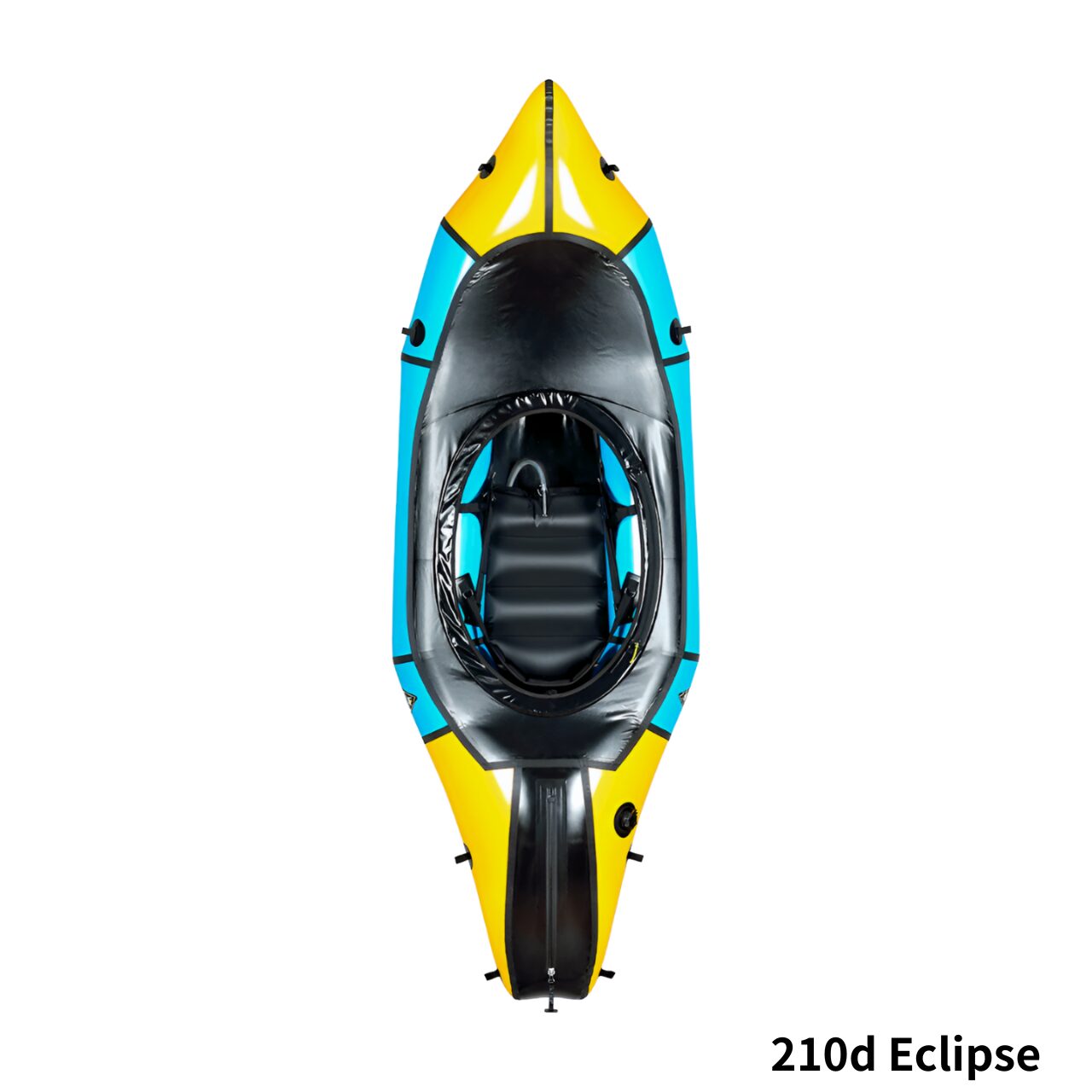
The AlpackaRaft Expedition is a river-trip-focused all-rounder that balances light weight with genuine on-water capability. It comes into its own on multi-day river journeys, loaded traverse-style trips, and routes that include current and moving water.
What the Expedition Is
The Expedition fills the gap from a lightweight model that doesn’t feel like enough to a dedicated whitewater boat that’s more than most people need. Alpacka built it around backcountry travel, expeditions, and linking rivers across terrain — the original packrafting philosophy, not a leisure-boat afterthought.
Three things define it: tracking stability and load balance from the longer hull, packable weight that stays within hike-in range without matching an ultralight model gram-for-gram, and genuine alignment with the classic packrafting style of hiking in and paddling out. It’s more stable than the lightweight models, more manageable than the dedicated whitewater boats — a balance point for travel and river performance.
Who It’s Right For, and Who Should Look Elsewhere
Who it suits
- River travel is the primary goal, with one or more nights of loaded paddling
- Hokkaido-scale or similar mid-size rivers
- Wanting a single long-term boat rather than an early upgrade
- Stability matters more than minimum weight
A quick check: if three or more of the following apply, the Expedition is likely a good fit — you want to do river travel; you’ll be paddling with gear on board; you want one boat for the long term; you’re thinking about Hokkaido-scale rivers or similar; stability is more important than light weight.
Who should look elsewhere
- Minimum weight is the priority, especially for UL hiking with the boat as a secondary tool
- Mountain lakes and calm water are the main fields
- Casual use a few times a year
- Dedicated, aggressive whitewater is the goal
- Wanting to start cheap and see if the sport sticks
It isn’t a beginner-only model, but for beginners who already know they want river travel, it’s a rational starting point. For pure flatwater day trips it can feel like overkill — but for anyone thinking ahead to overnight river trips or long-distance paddling in Hokkaido, starting with the Expedition is logical rather than wasteful.
Strengths — River Capability and the Cargo Fly
The Expedition’s strengths come down to four things:
- Stability — generous buoyancy keeps loaded trim balanced and absorbs moderate waves without drama
- Load capacity — handles everything from one-night outings to multi-day expedition loads
- Tracking — the longer hull holds a line with less constant correction, which matters over distance
- Durability — a practical-balance design rather than a weight-savings design, built to hold up over years of use
On the gear side, it ships with a 210d whitewater deck, thigh straps, and a Cargo Fly. The Cargo Fly is a zippered access port that lets gear be stored inside the tube itself rather than lashed to the outside of the boat — it keeps weight distribution more balanced and packing tidier, which suits the multi-day loads an expedition-style trip tends to carry.
Fit for Hokkaido’s Rivers
Hokkaido’s representative rivers tend to be relatively easy to read, long in distance, often reached via trail, and exposed to wind on wide sections. Those conditions reward exactly what the Expedition is built around: buoyancy, tracking stability, and load capacity.
Hokkaido river trips tend to come with full camping setups — tent, multi-day food, bear countermeasures, camera gear — and the Expedition holds loaded trim well under that kind of weight. It’s more wind-resistant than lightweight models on wide river corridors, though it’s worth being honest that strong wind on open flats or lakes challenges any packraft, the Expedition included. Rivers with sustained aggressive whitewater or technical WW-focused sections push past its best range — a more WW-oriented model is the better tool there.
Weaknesses and Common Regrets
Four weaknesses are worth understanding before buying.
- Not the lightest model. It’s built for the balance point between travel and river, not for minimum weight. Prioritize the Scout or Caribou LW if ultralight packability is the goal.
- Not a dedicated whitewater boat. It handles moderate moving water but isn’t built for big drops or sustained technical rapids — that’s the Gnarwhal or Mage’s territory.
- The price is high. US domestic production, high-quality materials, and RF-welded (radio-frequency welded) seam construction all show up in the price. The gap versus a budget packraft is largest in year one and narrows by year three or five.
- Wrong size means underperformance. Too small hurts load stability; too large makes the boat sluggish. Size selection isn’t something to guess at.
The common regret patterns map directly onto these four points: feeling it’s heavier than expected (usually a mismatch with UL hiking gear), feeling the price wasn’t worth it (usually low actual usage), expecting whitewater performance it wasn’t built for, and getting the size wrong by not accounting for gear load. All four are avoidable with a little upfront clarity about intended use.
On the durability point specifically: Alpacka Raft joins its fabric with RF welding rather than adhesive — heat and radio-frequency energy fuse the material at a molecular level, with far less delamination risk than glued seams over the long run. It’s part of what justifies the price gap over time.
Choosing a Size
Don’t decide by height alone. The four factors that matter are height, weight, how much gear you’ll carry, and the type of river you plan to paddle — and for river tripping specifically, how the boat performs loaded is what determines whether the size works.
Height guidelines (still-water baseline): up to around 170cm → S to M; 170–180cm → M as the center; 180cm+ or a larger build → L recommended. These are a starting point only.
Choose your exact size for day trips with a light gear load, where maneuverability and minimum weight are the priority. Go a size up for overnight or multi-day river trips, Hokkaido-scale rivers, routes with moving-water sections, or simply wanting room to grow into harder trips. Extra buoyancy in reserve keeps the boat stable, handles waves better, and stays easier to maneuver when loaded.
Common mistakes: choosing by looks, optimizing purely for minimum weight, and sizing by body weight alone without accounting for gear. The shift that matters — think of yourself plus your gear as the total load the boat needs to carry.
Comparison With Other Models
| Axis | Expedition | Lightweight models (Scout, Caribou LW) | WW-oriented models (Gnarwhal, Mage) |
|---|---|---|---|
| Weight | Mid-range | Lighter | Mid-range to heavier |
| Stability when loaded | High | Prone to instability when loaded | Depends on model |
| Tracking | Strong | Standard | Standard to lower (agility-focused) |
| Primary use | River travel, expeditions | Hiking-primary, ~70% hike / 30% paddle | Serious whitewater |
| Best fields | Mid-to-large rivers, Hokkaido river trips | Mountain lakes, day trips to light overnights | Sustained rapid sections |
The idea that lighter is always more versatile is a common misconception — weight and stability are a genuine tradeoff. When river travel is the primary use, the Expedition wins. When hiking is the primary use, a lightweight model like the Scout or Caribou LW wins. When aggressive whitewater is the goal, the Gnarwhal or Mage is the right tool. Once the use case is clear, the choice usually isn’t difficult.
Final Verdict
| Category | Rating |
|---|---|
| River travel suitability | ★★★★★ |
| Load capacity | ★★★★★ |
| Stability | ★★★★★ |
| Light weight | ★★★☆☆ |
| Whitewater suitability | ★★★☆☆ |
| Cost performance | ★★☆☆☆ |
The decision comes down to one question: is there a realistic chance you’ll do river travel? Yes means the Expedition is a defensible, rational choice. No means a lighter model will likely serve you better.
The AlpackaRaft Expedition isn’t a packraft for everyone. But for paddlers who want to hike in, paddle rivers, and complete the journey as a whole experience, it’s a polished, balanced boat that works as both a first serious packraft and a long-term keeper.
Related Link
→ Expedition 210d WW Deck, Thigh Strap, Cargo Fly [2026] https://packhokkaido.base.shop/items/119907066
Comments