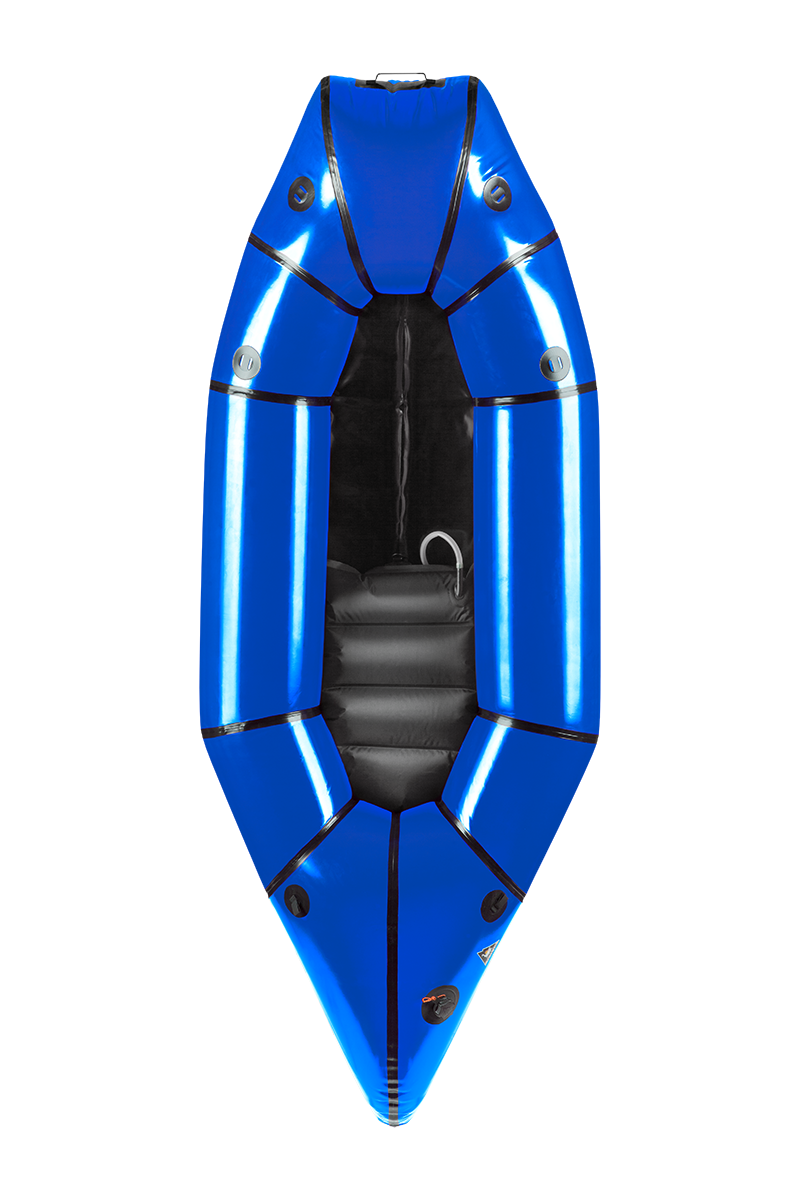
The Caribou is Alpacka’s balance model — stronger than the Scout, more agile than the Expedition. It’s built as a multi-purpose adventure packraft for flatwater and lightwater in the backcountry and sidecountry, and for bikepacking specifically.
What the Caribou Is
It’s designed for paddlers who want to cover a reasonable range of conditions with a single boat, without committing to a specialist model in either direction — “just enough strength” rather than a do-it-all boat. Where it lands in the lineup:
| Model | Character |
|---|---|
| Scout | Ultra-light, flatwater specialist |
| Caribou | Balanced, versatile |
| Expedition | Durable, river-travel focused |
The Scout is the entry point for water access, the Caribou is the everyday adventure tool, and the Expedition is for serious river travel. The Caribou fills the gap for paddlers who want mostly flatwater capability with some river thrown in.
Best Use Cases
The Caribou shines in three settings: lakes, calm rivers, and bikepacking.
① Lakes (still water) — this is where it performs most effortlessly. The boat is light and easy to approach on foot, the open deck makes loading and unloading straightforward, and tracking stability keeps paddling fatigue low over distance. For paddlers who hike into mountain lakes, its weight and packability directly expand the range of lakes within reach.
② Calm rivers (lightwater) — not a whitewater boat, but it handles rivers with gentle current, no major drops, and obstacles that can be read and avoided comfortably. This rewards a relaxed, exploratory style: paddle, stop somewhere interesting, land, relaunch.
③ Bikepacking — where the Caribou most clearly distinguishes itself. The bow has a gradual rise that makes lashing a bicycle natural, and the light build makes packing the boat onto a bike genuinely realistic. This combination has always existed as a concept; the Caribou is what makes it a practical, accessible reality.
For continuous whitewater, cold or rough conditions, or wanting one boat to cover every category, the Expedition or a more rigidity-focused model is the better fit.
Open Deck vs Self-Bailer
Open deck is the lightest, simplest, most economical configuration — no spray deck, no drainage. Best for flatwater, lakes, calm rivers, fishing, camping, touring, and a first packraft. Strengths are weight, simple setup, and price; weaknesses are water pooling when waves hit, weaker whitewater capability, and cold exposure in cold conditions.
Self-bailer drains water that enters the cockpit automatically, with a 3/4-length, 7-inch-thick seat aft and a baffled footbrace forward. Best suited to downriver paddling in mild conditions, fast entry and exit, and situations where taking on water is expected. Strengths are no water accumulation, easier recovery after a flip, and moderate whitewater capability; weaknesses are slightly more weight, more drag on flatwater, and more cold exposure.
| Factor | Open Deck | Self-Bailer |
|---|---|---|
| Weight | ◎ Very light | ○ Slightly heavier |
| Simplicity | ◎ | ○ |
| Downriver | △ | ◎ |
| Flatwater | ◎ | ○ |
| Beginner fit | ◎ | ○ |
| Drainage | × (manual) | ◎ (automatic) |
Open deck is the default choice for a first packraft, lakes and calm rivers as the main field, and prioritizing light weight and price. Self-bailer makes sense for downriver-focused paddling, frequent water exposure, and wanting room to grow toward whitewater later.
Is the Self-Bailer Cold?
By design, the self-bailer keeps feet in frequent contact with water, a small amount is always flowing through, and wind plus water pulls heat away more effectively. When cold water, cold air, and long stationary stretches overlap — early spring or autumn snowmelt, cold regions like Hokkaido, long flatwater sessions, fishing-style use — the cold becomes noticeably uncomfortable.
That said, the self-bailer’s advantages often outweigh the cold concern: no bailing needed, more confidence on moving water, dramatically easier recovery after a flip, faster entry and exit. For paddling where getting wet and staying in motion is the point, it tends to win.
Three practical fixes: a drysuit or dry pants (the most effective option, and close to essential gear for cold-season paddling in Hokkaido), neoprene socks or boots (3–5mm makes a real difference given how much foot chill affects overall comfort), and not forcing the self-bailer in cold conditions — open deck for cold seasons, self-bailer when it’s warm, chosen by season and field rather than by habit.
Fabric Choice: LW210d vs STD210d
“210d” refers to denier, a measure of thread thickness — higher numbers mean heavier, thicker fabric. But 210d does not mean fragile. Alpacka’s LW210d features high-quality TPU coating and a hull design built around the fabric’s characteristics, with a real field-use track record behind it.
LW210d is built for lakes and still water, calm rivers with few rapids, bikepacking, and backpacking-approach trips. Within that range, durability isn’t an issue under normal use. Actively running whitewater, repeatedly dragging the hull over rocky shallows, or paddling heavily loaded into rough water pushes past what it’s optimized for.
The Caribou’s durability comes from the whole design, not the hull fabric alone: a weight-optimized build that skips unnecessary reinforcement, a hull shape built to handle cargo loads, and a separately designed 840d nylon floor where contact and stress actually concentrate. Dragging the hull across shallow rocky riverbeds, landing on rocks at high pressure, and repeatedly running abrasive lines are habits to avoid with any lightweight fabric, not just this one.
STD210d adds roughly 0.34kg for meaningfully more peace of mind on durability, and is a natural choice for paddlers who want to use the boat across a wider range of conditions without thinking too hard about it.
Comparison With Other Models
Is the Caribou a good first packraft? For flatwater-focused use, a strong yes. For mixed flatwater-and-river use, a strong candidate. For whitewater-primary use, the Expedition’s WW deck, thigh straps, and cargo fly provide more capability and safety margin.
The Caribou fits paddlers who want versatility without a weight penalty — lakes plus some river, bikepacking, casual downriver — and paddlers for whom the Scout feels a bit underpowered but who aren’t ready to commit to heavy river use. For serious whitewater or heavy loaded long-distance travel, the Expedition is the better fit.
Choosing It as a First Boat
The Caribou is less a way to get from A to B and more a tool for expanding what’s possible — lakes, rivers, and bikepacking combined in ways that wouldn’t otherwise be practical. Light weight, load capacity, and ease of handling are all designed in the same direction: more places, more days on the water.
It’s a good fit if this is a first packraft, the primary fields are lakes and calm rivers, bikepacking is something worth exploring, and light, compact gear matters. Deck configuration and fabric aren’t about which option is “better” — they’re about which one matches the field being paddled.
Related Links
→ Caribou LW210d Open Deck [2026] https://packhokkaido.base.shop/items/119777235
→ Caribou STD210d Open Deck [2026] https://packhokkaido.base.shop/items/119786147
→ Caribou LW210d Self-Bailer [2026] https://packhokkaido.base.shop/items/119859159
→ Caribou STD210d Self-Bailer [2026] https://packhokkaido.base.shop/items/119860457
SEO Title: Alpacka Raft Caribou — Complete Guide: Uses, Deck, Fabric
Meta Description: A complete guide to the Alpacka Raft Caribou — best use cases, open deck vs self-bailer, fabric choice, and how it compares to other models.
Category: アルパカラフト, カリブー Suggested Tags: AlpackaRaft, Caribou, open deck, self-bailer, bikepacking
コメント