Ultralight trips with almost nothing in the boat and ultraheavy trips packed for several nights are both part of packrafting. But where you put the load changes how the boat moves. The difference shows most when weight piles up in the bow, and you need to get in and out of an eddy.
Light or heavy, both have their place
On a day trip you hardly carry anything: boat, paddle, PFD, helmet, a change of clothes, some water. The boat is light and turns when you ask it to.
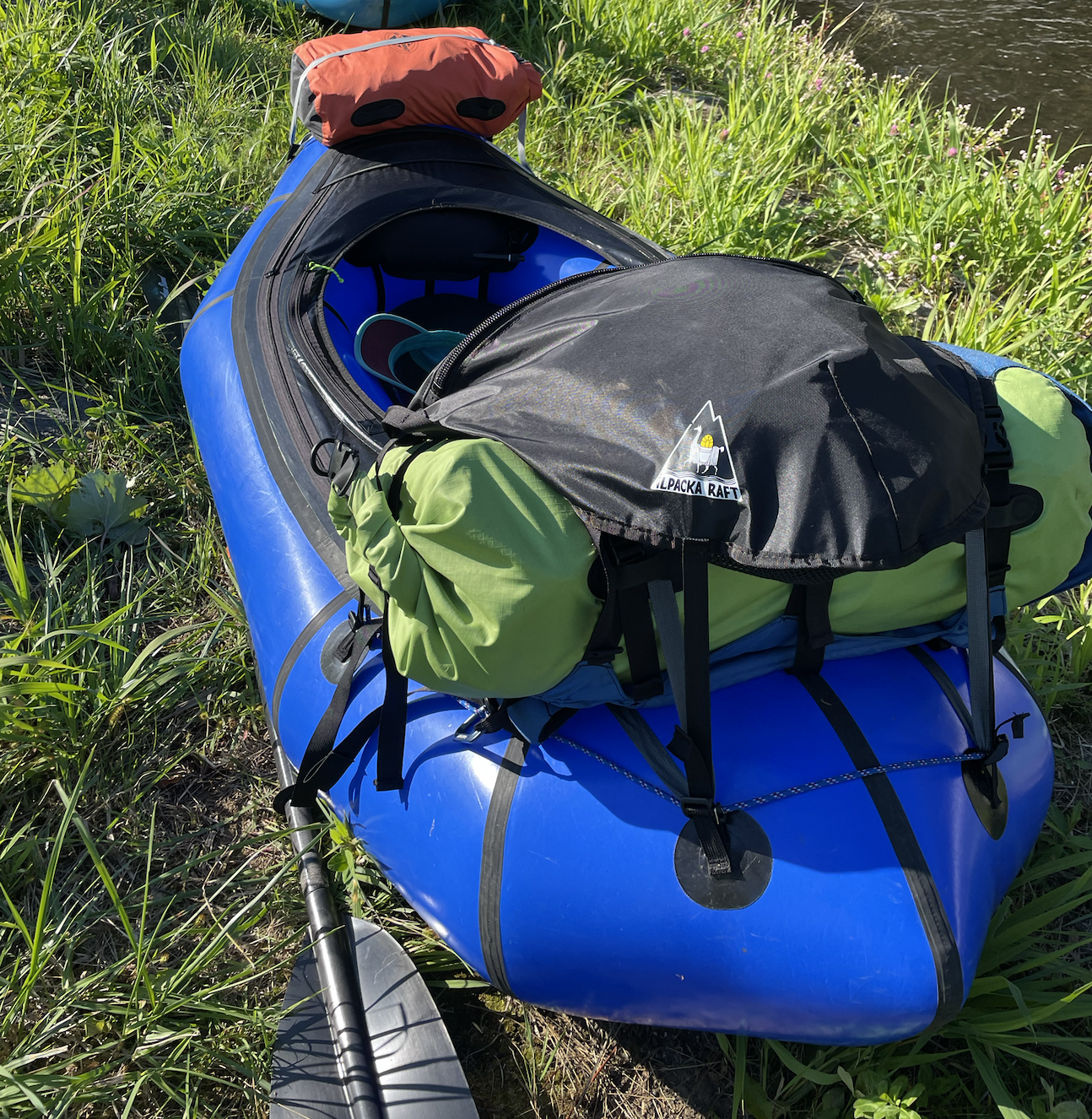
An overnight river trip is another story. Tent, sleeping bag, pad, food, water, a stove. The photo is from September on the Kushiro River in eastern Hokkaido, on a through-paddle of about 100 km from Lake Kussharo to the Pacific, with four days’ worth of gear on board. The build-up to that trip starts with I’ve Decided to Join the Kushiro River Expedition.
Neither way is the right one. Match the load to how far you walk, how many nights you stay out, and what the river is like. What goes into an overnight kit is covered in Packrafting Overnight — What to Add for a River Trip in Hokkaido.
Where the load goes
Some Alpacka Raft models have a Cargo Fly: a waterproof TIZIP zipper at the stern that lets you stow gear inside the tubes. With a Cargo Fly, the heavy items can go inside the boat.
On models without one, the gear goes into a 65-liter Sea to Summit Big River Dry Bag, strapped on top of the bow. The boat in the photo carries a bow bag with a green dry bag on top. Bow bag options are covered in the AlpackaRaft Accessory Guide.
It’s a simple setup, and everything is easy to reach. But it puts the weight in the bow.
What a heavy bow does
A bow-heavy boat is slower to turn. A single stroke that would normally swing the boat around may not get it all the way.
Where it matters most is getting in and out of eddies.
An eddy is the spot behind a rock or a point on the bank where the current slows or curls back upstream. You use it to rest out of the main flow or to get to shore. Going in or out means crossing the line between fast water and still water, so the boat has to change direction quickly.
On either side of that line, the water moves in opposite directions. The bow crosses first, so for a moment the bow is in one current and the rest of the boat is still in the other. A light bow lets the boat swing around with that push. A heavy bow gets shoved harder in that moment.
So with a loaded bow, you need a solid lean as you cross. Without it, the current can grab the bow on the way into an eddy or on the way out, and flip the boat.
Plant the paddle deep
If the boat won’t come around, put the paddle in deeper. Bury the blade, catch the water, then pull.
If you already paddle with a deep catch, a loaded boat won’t give you much trouble. With time, you get a feel for how much more movement a loaded boat needs.
Try it loaded before you head out
Until it feels natural, check how the boat handles with the load before you set off. Find a calm spot near shore and try three moves:
- Eddy in: from the main current into an eddy
- Eddy out: from the eddy back into the current
- Ferry glide: angle the boat against the current and cross sideways without getting carried far downstream
Moves you’ve practiced in an empty boat change once it’s loaded: how far you lean, how you place the paddle. Learn that difference before you get into stronger water.
The quickest way to learn: go with a guide
The quickest way to learn to read and paddle a river is to join a local guided tour and let a guide show you the basics: how to spot an eddy, how to cross the line, how to lean a loaded boat. One lesson on the water beats a lot of reading and video.
Packraft guides in Hokkaido are listed in our Hokkaido packraft guide list (Japanese). For why to start out with experienced paddlers, see Start Packrafting with Someone Who Knows Rivers, and for river terms, River Knowledge Worth Knowing — Niseko Ukka on Terms and Signals.

Comments