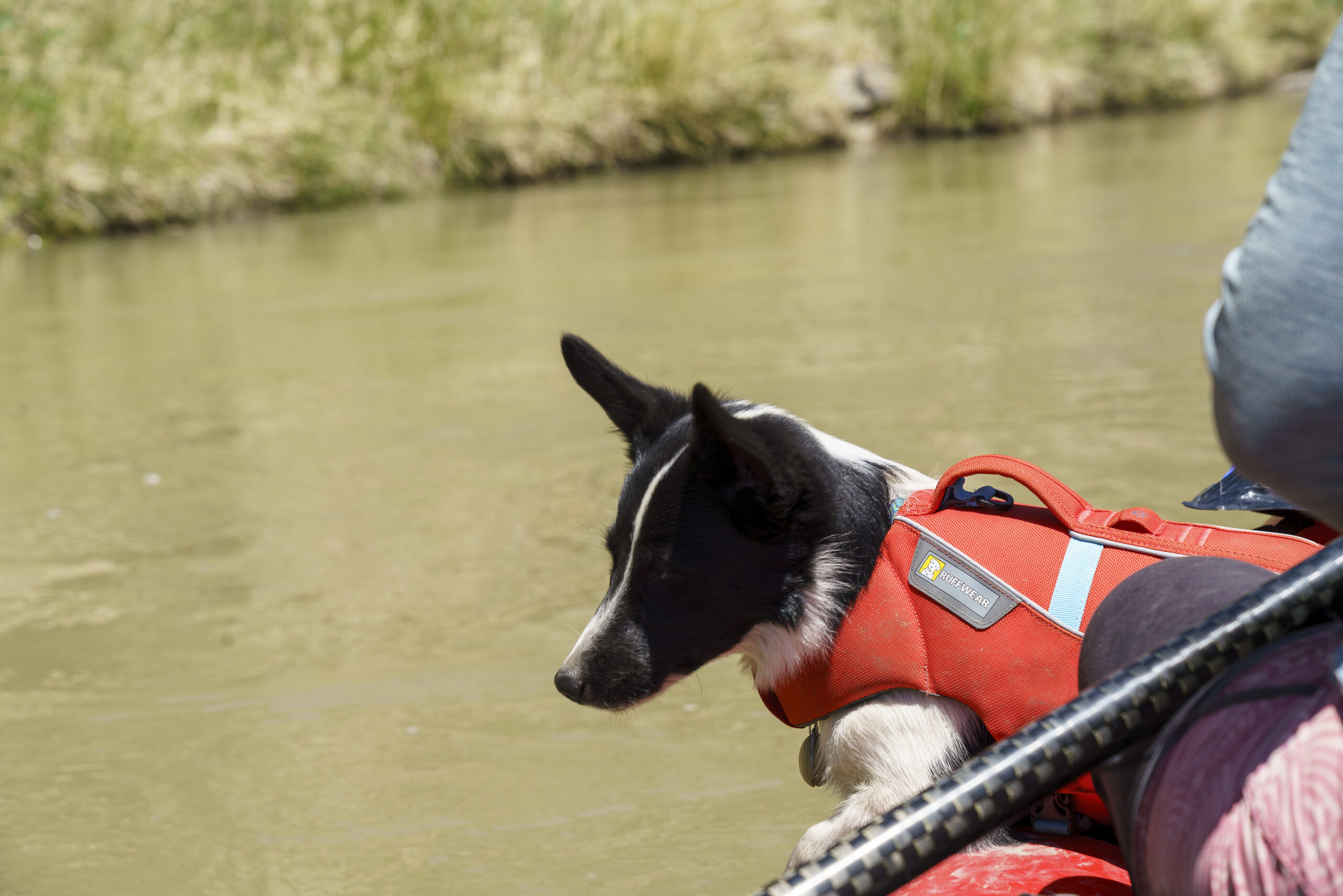
Dogs like water. And they adapt to packrafts more readily than most people expect. The problem is that not every packraft is actually safe for paddling with a dog. Forward space, buoyancy, stability, and load capacity all need to be in place at once. The Mule addresses all four — which is why it’s one of the very few packrafts that genuinely works for canine co-paddling.
Why Forward Space Matters
The Mule’s bow tapers gradually, creating open foot space rather than a tight cockpit. Interior dimensions are 132 cm in length and 39 cm in width. That space allows a medium-sized dog to lie flat forward without crowding the paddler. A larger dog can extend its front legs. Gear and the dog can occupy separate positions rather than competing for the same real estate.
A dog that isn’t cramped is a dog that stays calmer — and a calmer dog means a more stable boat.
Dogs Move Without Warning
A dog spots a bird and stands up. It leans toward the water to investigate a smell. It turns around for no apparent reason. Any of these movements transfers weight abruptly to one side. In a small, low-buoyancy boat, that kind of shift can be genuinely dangerous.
The Mule’s high-buoyancy hull resists positional instability from sudden weight changes. That resistance is the structural difference between a startling moment and a stable one — and it’s not something that can be improvised with technique alone.
Load Capacity = Safety Margin
Paddling with a dog means bringing more gear: dog PFD, leash, towel, drinking water, food. Gear accumulates, and it does so predictably. The Mule’s load headroom means you don’t have to choose between taking the dog and taking the safety equipment. Margin in load capacity translates directly into margin in the decisions that matter.
Why Open Deck Works Well for Dogs
The Mule’s open deck configuration is the more practical setup when a dog is on board. Getting the dog in and out is straightforward without a spray deck in the way. If the dog jumps in or goes overboard, retrieval is easier. Any water that enters drains more readily. The current Mule lineup covers open deck and self-bailer configurations — both are manageable setups for dog paddling under calm to moderate conditions.
Practical Notes for Dogs on the Water
A dog PFD is non-negotiable regardless of how well the dog swims. Start the first sessions on calm, shallow water where both the paddler and the dog can build confidence without high stakes. Dogs that react strongly to movement — birds, other animals, passing boats — need extra attention in open water. Consider a mat or cockpit pad to protect the hull from claw contact. 210d fabric handles most use cases well, but if the dog will be on board frequently rather than the boat being carried long distances on foot, 420d provides a more comfortable durability margin.
What Paddling with Your Dog Actually Means
Dogs are family. A morning on the lake. A quiet river bend. A calm inlet at the end of a trail. Being able to bring your dog changes what those places feel like — and what the whole trip is.
The Mule gives you the space to make that happen without compromising the experience or the safety of either of you on the water.
Summary
For paddling with a dog, you need forward space, high buoyancy, hull stability, and load headroom. The Mule is one of very few packrafts that provides all four without meaningful compromise. Not just “the dog can fit” — the dog can be comfortable, and you can paddle together safely.
コメント