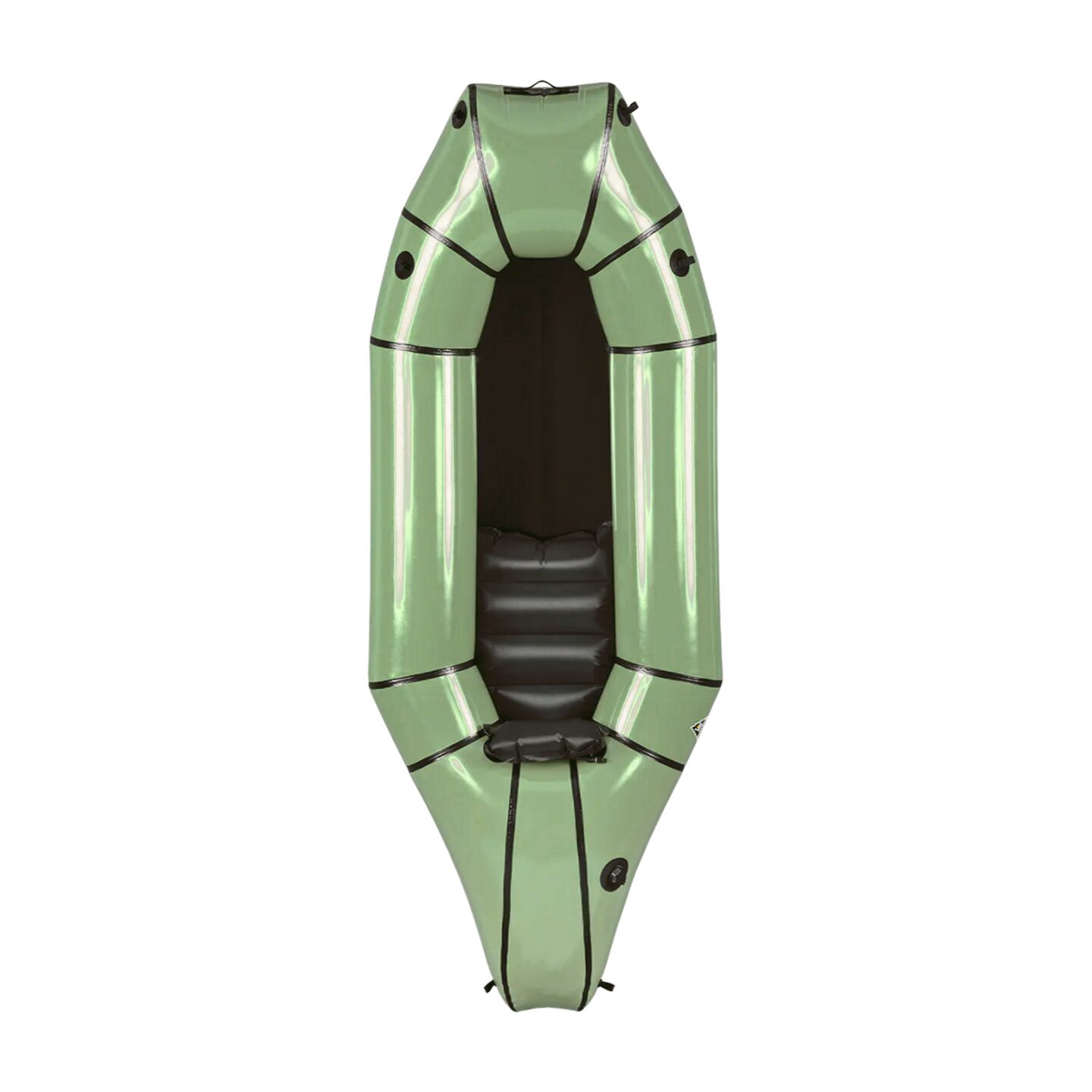
The Mule is not a speed model. It’s not an expedition cruising model. The Mule’s core value is margin — the headroom between what you’re carrying and what the boat can handle without becoming difficult to control. For larger paddlers, heavy loads, dogs on board, and backcountry hunting, that margin matters more than being light or fast. The Mule is designed for exactly those situations.
Why “Mule”?
A mule is an animal bred to carry loads — reliably, across terrain, without complaint. The name is direct and accurate. The Mule is designed around that same premise: a large-volume hull, high buoyancy, and wide interior space, built from the start to carry rather than to sprint. It isn’t a wider version of another packraft. It’s a hull optimized for load as the primary design requirement.
High-Volume Hull Design
The Mule’s center-back stern, high-volume body provides buoyancy well above what standard packrafts offer, meaningful resistance to hull sink under load, and inherent stability that doesn’t depend on paddler technique to maintain.
It is recommended for paddlers 173–203 cm in height, with paddler weight capacity up to approximately 117 kg. With a dog or additional passenger, the total supported weight extends to approximately 136 kg. This is what margin feels like before you begin pushing it.
Foot Space and Interior Room
Interior length is 132 cm, interior width 39 cm. The gradually tapering bow creates open foot space that accommodates large dry bags, coolers, hunting gear, and dog mats without the cramping typical of most packrafts. Space inside a packraft isn’t just comfort — it determines how well gear can be positioned, how stable the distributed load becomes, and how much cognitive energy is spent managing the cockpit across a long day. The Mule makes all of this measurably easier.
Deck Configuration Options
The Mule is available in two deck configurations: open deck (lighter, simpler, easier for dog access) and self-bailer. Cargo fly internal storage can be added as an option to either. This covers the full range from casual day paddling to serious backcountry missions within the same hull platform, without requiring a different boat.
Fabric Choice: 210d or 420d
The 210d version weighs approximately 3.2 kg in open deck configuration — the right choice for trips where packability and carry weight are primary concerns. The 420d adds approximately 270 g but meaningfully increases abrasion and puncture resistance for rough terrain entry, rocky landings, and repeated contact with hard surfaces. The choice comes down to the terrain: forest carries and rocky approaches favor 420d; packability-focused use favors 210d.
Load Capacity Potential
With cargo fly internal storage, approximately 45 kg can be stored inside the hull. Total load capacity can exceed 90 kg under appropriate conditions. For hunting use, the Mule is designed to carry a hunter plus approximately 45 kg of field equipment plus up to 68 kg of harvested game. Under favorable conditions and with appropriate experience, maximum supported weight reaches 272 kg. This is not a recreational boat being pushed beyond its design limits — this is the use case it was built for.
Who the Mule Is For
Larger paddlers who find standard packrafts cramped or low in the water under their weight. Paddlers carrying heavy multi-day kit with no interest in cutting safety margins to save grams. Anyone bringing a dog on the water. Hunters and backcountry users who need the boat to bring game or gear back out as well as in. Paddlers who want clear headroom in load capacity rather than operating near a boat’s limits on every trip.
The Mule is not the right choice for weight-first or speed-first priorities. It is the right choice for paddlers who prioritize confidence and margin over minimalism.
Summary
The Mule doesn’t attract the attention of lighter or more technically demanding models. But for the paddler whose conditions genuinely require it, the Mule is the most rational choice in the AlpackaRaft lineup. Load capacity, buoyancy, stability, interior room — these are not secondary features. They are the design.
“Isn’t this a bit big?” is the wrong question. The right question is: how much margin do I actually need? The Mule is the answer when the honest answer is: more than most packrafts offer.
コメント