Note: Packraft use in hunting contexts is uncommon in Japan. This article is written as reference material — primarily for international readers and paddlers exploring the outer limits of what the Mule’s load capacity makes possible.
In hunting and serious backcountry use, carrying is more important than paddling. Personal kit, food, safety gear, and harvested game. Standard packrafts reach their load limits quickly. The Mule’s load ceiling is meaningfully higher.
Realistic Load Scenarios
The manufacturer’s intended use case includes a hunter plus approximately 45 kg of personal equipment plus approximately 68 kg of harvested game. Under favorable conditions with appropriate experience, further loading is possible — with a stated maximum load figure of 272 kg under optimal conditions.
The number itself is less important than what it represents: the Mule maintains stability under load that would compromise other packrafts. That’s the actual value.
What High Buoyancy Means in the Field
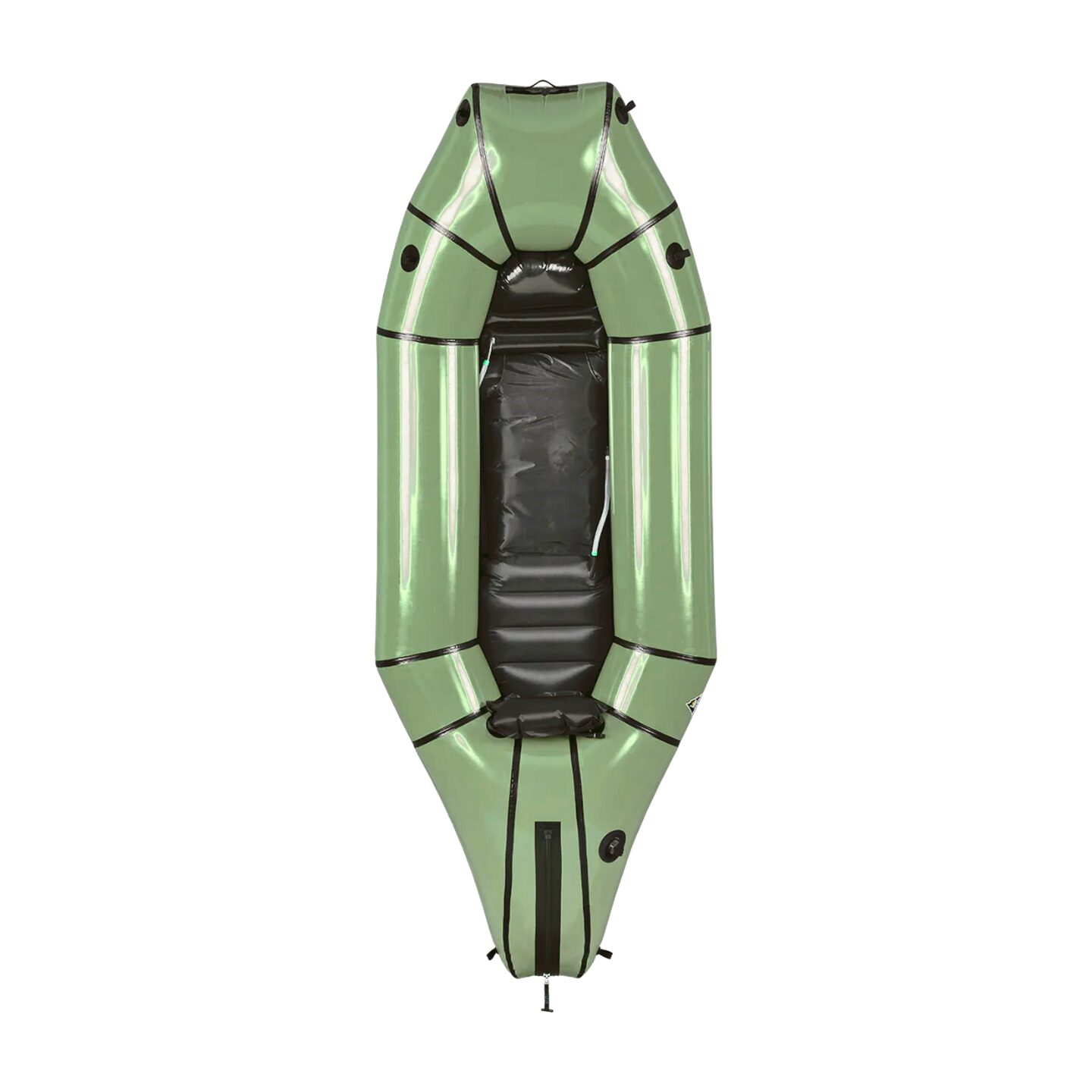
The Mule’s center-back stern high-volume hull resists hull sink under heavy loading, maintains trim with distributed weight, and tolerates load imbalances without becoming unstable. Hunting loads are rarely evenly distributed — game is bulky and irregular, and gear placement in the field rarely resembles a controlled packing scenario. A hull that tolerates this kind of variance is a hull that’s usable for the actual mission.
420d Fabric in Rough Terrain
Backcountry entry means shallows, rocks, brush, and rough launches. The hull will contact things. 210d is lighter and packs down smaller — the better choice when the packraft is carried frequently on foot. But when the terrain involves repeated contact with abrasive surfaces, the 420d’s durability improvement is meaningful.
The weight cost is approximately 0.27 kg. The durability gain is clear. If abrasion contact is expected rather than occasional, 420d is the rational choice.
Cargo Fly Addition for Heavy Loads
With cargo fly: internal storage capacity of approximately 45 kg, lowered center of gravity, reduced wind profile. For heavy or dense loads like game, the ability to store weight inside the hull — rather than piling it on deck — meaningfully improves stability and makes longer distances realistic rather than exhausting.
Why Packraftability Matters
A hardshell kayak cannot be carried into backcountry access points. Portaging is impractical at scale. Entry is restricted to water-accessible locations.
The Mule in 210d open deck configuration weighs approximately 3.2 kg. It can be carried through forest, used to move game or gear via water routes, and carried back out again. The ability to link land and water in a single piece of kit is the primary operational advantage of the Mule in backcountry contexts — and it’s something that no rigid kayak can offer.
What Backcountry Packrafting Actually Requires
The Mule is not a flashy model. In conditions that are heavy, voluminous, or rough, its value becomes clear. Ultralight performance isn’t the point here — load capacity and buoyancy are the operational requirements, and the Mule is built around them in a way that almost no other packraft matches.
Summary
Hunting and serious backcountry use demands load capacity, stability, durability, and portability simultaneously. The Mule achieves a practical balance of all four. It’s a packraft that functions as a mission tool, not just recreational equipment.
コメント