
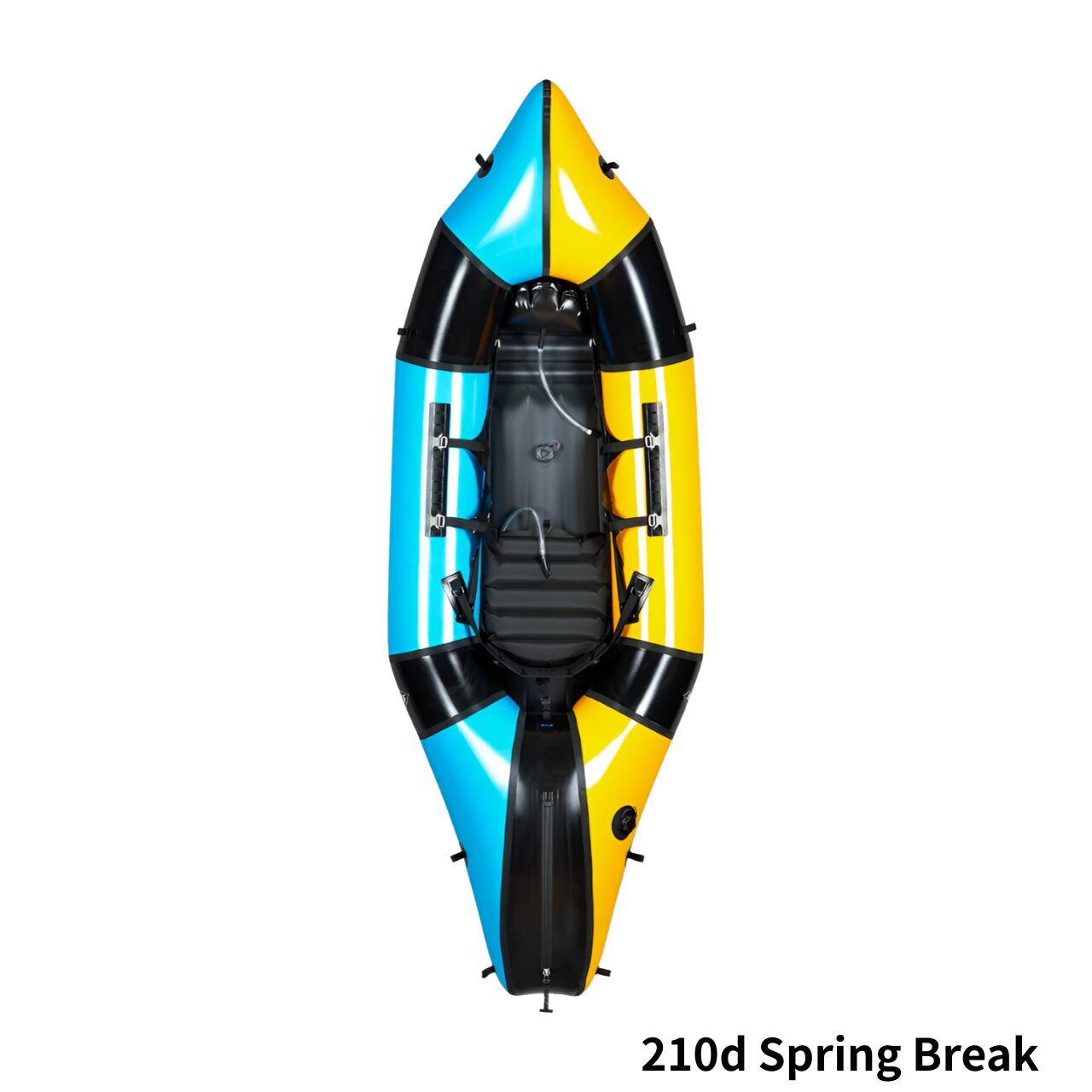
The Mage is a fast-packing-compatible whitewater packraft, built to combine light weight with real technical performance. It’s not a boat for paddling easily — it’s a boat for paddling better. It reflects the paddler’s input directly and honestly, which is exactly what makes it so compelling for the right person.
What the Mage Is
Packrafts have historically split into two categories: stable touring models heavy enough to carry serious gear, and lightweight hiking models that sacrifice handling on technical water. Real-world use has shifted — more paddlers are combining long approaches with technical river descents, particularly in alpine zones and headwater terrain, where long approaches, demanding water, and short descents define the trip. Existing models didn’t fully serve that use case: a touring boat handles the water but adds weight to the hike, while a lightweight model keeps the pack manageable but underdelivers in technical current. The Mage was built to dissolve that tradeoff.
Light weight extends range; handling expands which rivers are on the table. Within Alpacka’s lineup, the positioning is clear: the Expedition covers load capacity and long-range travel, the Gnarwhal covers accessible, stable whitewater, and the Mage covers speed, precision, and low weight.
Who It’s Right For, and Who Should Look Elsewhere
Who it suits
- Paddlers who want to read and run rather than simply descend — catching eddies, cutting across current, threading lines
- Paddlers looking for a kayak-like feel, steering through current rather than floating with it
- Paddlers focused on skill development, where feedback is immediate and a boat that keeps giving back as skill improves matters
- Regular whitewater paddlers — the more frequently you’re on moving water, the more value it returns
- Paddlers who value agility over mass: fast response, sharp turns, quick acceleration
- Paddlers who measure a session by depth rather than distance
Who should look elsewhere
- Anyone who wants to relax and take in the scenery — slow lake paddling, scenic floats, long breaks. The Mage requires active posture maintenance throughout
- Paddlers who need load capacity. Loading it shifts trim, drops the stern, and dulls handling
- First-time packraft buyers. Paddling it well requires edging, ferry glides, bottom control, and an understanding of current speed
- Paddlers who prioritize passive stability over active control
- Long-distance paddlers — there’s no relaxed neutral position, and fatigue accumulates faster than on a touring-oriented model
- Anyone wanting one boat for all seasons. It performs best on whitewater-focused days specifically
The Mage isn’t a low-performance boat — it’s a narrow-use boat. Evaluated in the wrong context it underperforms; evaluated in the right one, there’s nothing else quite like it.
Design Details — How It Achieves Both Light Weight and Real Performance
The Mage’s character comes from design intent, not material reduction. Every structural element serves a specific purpose.
- Reduced tube diameter — a narrower profile means edging works, ferries hold, and eddy entries stick. The shift is from a boat that floats passively to one you actively steer
- Long waterline — more contact with the water surface means better directional stability and less deceleration between strokes. Weight carries you; length moves you
- Sharp bow shape — the bow parts water rather than rising above it, grips the surface, and holds ferry angles under pressure, improving line reproducibility
- Low deck, low center of gravity — tube height and seat position are set lower, so the boat responds proportionally to tilt, producing a handling feel closer to a kayak
- Light construction — faster acceleration, easier micro-corrections, and sustained concentration without fatigue; weight here serves precision, not just packability
- Minimal-load philosophy — the boat isn’t designed for cargo, and keeping load light is what keeps it riding correctly on the water
Venturi Flaps and the One-Piece Air Floor
The self-bailer configuration features Venturi Flaps — a flap structure at the floor drain holes with mesh positioned on the inside, letting water drain freely outward while suppressing backflow from below the hull. Beyond drainage and waterproofing, the flap geometry also reduces drag along the hull bottom, contributing to speed through moving water.
The Mage’s on-water feel doesn’t come from the flaps alone. Like the Valkyrie, it features a one-piece, integrally molded air floor across the full cockpit bottom, directly addressing the secondary-stability weakness that’s a well-known trait of packrafts generally — the boat tilting and flipping before there’s time to react. A rigid floor gives a firm, continuous surface to push against when edging or bracing.
Self-bailer construction, Venturi Flaps, and the one-piece air floor together make the Mage what many dedicated whitewater packrafters describe as the boat they eventually settle on.
What Rivers Does It Suit?
It’s not about river size — it’s about how much active paddling the river demands. The more decision-making and technical input required, the better the Mage performs.
| Field type | Suitability |
|---|---|
| Technical small-to-mid rivers | ◎ Best match |
| Headwaters / mountain streams | ◎ Excellent |
| Creeks | ○ Technical paddlers |
| Long touring downrivers | ○ Possible, not optimal |
| Big water | △ Paddler-dependent |
Technical small-to-mid rivers are where it performs best — shallow, rocky, narrow lines with frequent sequential decisions reward handling precision over raw stability. Headwaters and mountain streams suit the hike-in, paddle-down style of adventure it’s built for, light enough for long approaches and maneuverable enough for boulder gardens. Creeks are within reach for paddlers who can scout lines and execute ferries and eddy catches reliably, but it offers no stability margin for passive descents. Long downrivers are possible but not ideal — limited buoyancy reserve and loaded trim work against it. Big water favors the Gnarwhal’s stability; the Mage is a line-selection boat, not a wave-survival boat, though skilled read-and-run paddlers can still use it effectively there.
Choosing a Size
The Mage isn’t a touring boat, and sizing follows from that. The right question isn’t which size feels most comfortable — it’s which size gives the most control. Sizing up for comfort is the most reliable way to underperform the boat.
Base height guidelines: up to 168cm → S; 168–178cm → M; 178cm+ → L. For whitewater use, sizing toward the smaller end of the range is often correct.
The Mage has a lower cockpit than most packrafts, a stronger leg angle, and is designed to be controlled with the knees — a fit closer to a kayak than a touring packraft. Sizing up produces real, measurable consequences: edging doesn’t engage, turns lag, boofs land flat, waves push back instead of being cut, and roll becomes heavier — sizing errors, not technique errors. Sizing down, by contrast, has minor consequences: legs bend a bit more, long sessions get slightly less comfortable, but handling improves.
Leg length (inseam) matters more than body weight here. By water class: Class II–III takes the standard size, Class III–IV goes one size down, and technical rivers call for smaller as essential. The most common mistake is sizing up for extra room — pure touring-boat thinking that costs roughly half the boat’s handling capability on the Mage. The priority order is handling first, integration second, comfort last. When in doubt, size down.
Final Verdict
The Mage isn’t a boat for everyone. But rather than trying to suit everyone, it returns maximum enjoyment to the paddlers it does suit — and the clearer the purpose going in, the longer it stays the boat someone reaches for.
It fits paddlers targeting headwaters and upper river zones, combining long-distance hiking with river descents, wanting to enjoy line selection and technical paddling, and minimizing total gear weight. It’s not the right choice for a first packraft, a relaxed touring experience, substantial load capacity, or a preference for stability over responsiveness — the Expedition or Gnarwhal serve those needs better. The Mage isn’t a travel boat. It’s a boat for enjoying the line.
Related Links
→ Mage 210d Self-Bailer with Cargo Fly [2026] https://packhokkaido.base.shop/items/120227980
→ Mage 420d Self-Bailer with Cargo Fly [2026] https://packhokkaido.base.shop/items/120228753
→ Mage 210d WW Deck with Cargo Fly [2026] https://packhokkaido.base.shop/items/120229958
→ Mage 420d WW Deck with Cargo Fly [2026] https://packhokkaido.base.shop/items/120230676
Comments